
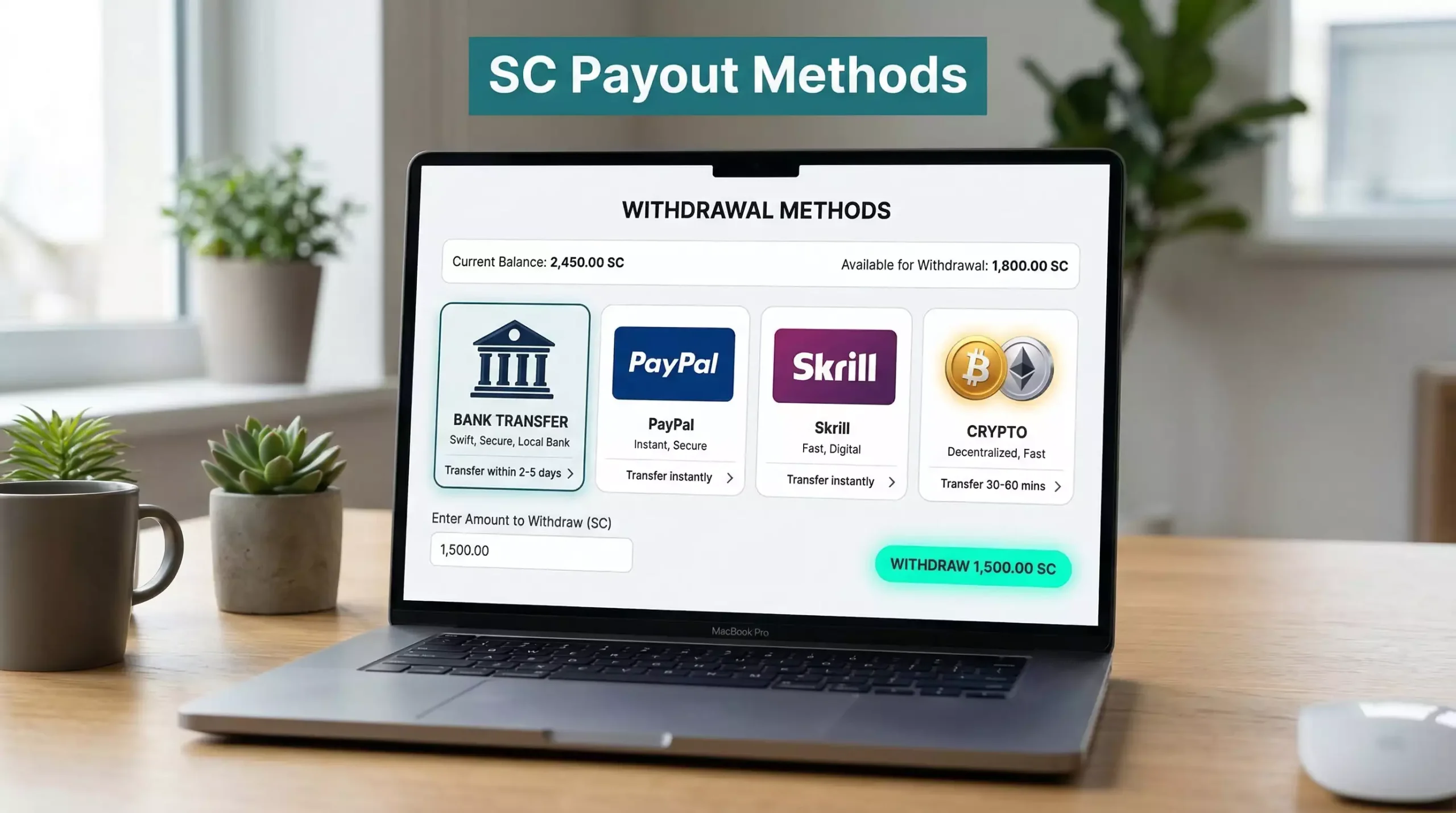
The payout method you choose at a sweepstakes casino determines two things: how fast your money arrives and how much friction you encounter getting it there. Bank transfers, PayPal, Skrill, and cryptocurrency each offer different trade-offs between speed, availability, and convenience — and the options available to you depend entirely on which platform you use. There is no industry standard for payout methods, processing times, or minimum redemption thresholds. Each operator sets its own terms.
This article compares minimum redemption thresholds across platforms, breaks down processing times by method, and evaluates each payout option on the metrics that actually matter when you’re trying to convert Sweeps Coins to cash in your account. The focus here is comparative — not the step-by-step redemption process (covered elsewhere), but a side-by-side analysis of how platforms differ on the money-out side of the equation.
Minimum Redemption Thresholds by Platform
Minimum redemption thresholds — the smallest amount of redeemable SC you can cash out — vary widely and have a direct impact on whether no-deposit and low-deposit players can ever reach a withdrawal.
Chumba Casino sets one of the higher minimums at 100 SC ($100 equivalent). For a player relying on daily logins and free entry, accumulating 100 redeemable SC without making a purchase is a slow and uncertain process. LuckyLand Slots, also operated by VGW, sets its minimum at 50 SC — lower, but still a meaningful bar for purely free-play users.
WOW Vegas and Pulsz have set lower thresholds in the range of 10–50 SC depending on the payout method, making them more accessible for smaller-balance players. Some newer platforms push even lower — as little as 5 or 10 SC — as part of their acquisition strategy, signaling to potential players that the redemption pathway isn’t gated behind large balance requirements.
The scale of payouts flowing through these thresholds is enormous. VGW’s platforms alone disbursed $2.83 billion in sweepstakes prizes in a single fiscal year, according to financial reports disclosed through court filings. That figure represents millions of individual redemptions processed through the same threshold and method infrastructure that every player navigates.
The absence of standardized thresholds across the industry reflects the unregulated nature of the market. As Bill Miller, President and CEO of the American Gaming Association, has stated: “These illegal operations exploit consumer confusion and threaten to undermine the public trust we have built over many years.” Without a licensing body to set minimum standards for payout terms, each platform designs its threshold to optimize its own economics — which doesn’t always align with player convenience. Platforms with lower thresholds are making a player-friendly choice, but it’s a voluntary one that can change at any time.
Processing Times: How Long Each Method Takes
Processing time is measured from the moment your redemption is approved (post-KYC, post-review) to when the funds are available in your account. The approval stage itself — including KYC verification for first-time withdrawals and manual review for flagged transactions — adds additional time that varies by platform.
Bank transfer (ACH) is the slowest standard method. Processing typically takes 3–5 business days after approval at most platforms, with some newer operators stretching to 7+ days. Expedited ACH options are emerging at select platforms, reducing the window to 1–2 business days, but this isn’t universal. Bank transfers are available at every sweepstakes casino that processes payouts, making them the universal fallback.
PayPal offers faster processing — typically 1–3 business days post-approval — where available. Not every platform supports PayPal payouts, and some restrict it to players who made at least one PayPal deposit. But for platforms that offer it, PayPal is the best balance of speed and simplicity for most US players.
Skrill processes at speeds comparable to PayPal (1–3 business days) but is available at fewer platforms and may carry its own withdrawal fees. Players who already use Skrill for other online transactions may find it convenient, but it’s rarely the optimal choice if PayPal is also available.
Cryptocurrency payouts are the fastest option at platforms that support them — sometimes processing within hours. Stake.us and a handful of other crypto-forward platforms can send Bitcoin, Litecoin, or stablecoin payouts that clear in minutes once approved. The speed advantage is real and significant for players who maintain crypto wallets. The trade-off, as covered in crypto-specific analysis elsewhere, is price volatility for non-stablecoin payouts.
For context on the money flowing through these channels: sweepstakes operators return approximately 68–72% of total sales as prizes through the SC channel, according to RG.org’s analysis. That percentage represents billions of dollars in annual payouts — real money moving through real payment channels at varying speeds depending on which method and platform the player chose.
Method-by-Method Comparison: Bank, PayPal, Skrill, Crypto
Choosing the right payout method means matching your priorities — speed, convenience, fees, privacy — against the options available at your platform.
Bank transfer is the baseline. Available everywhere, accepted by all banks, and carries no platform-side fees at most operators (though your bank may charge for incoming ACH). The downsides are speed (slowest option) and the requirement that your bank account name match your sweepstakes account name exactly. For players who prioritize simplicity and have no urgency about receiving funds, ACH is perfectly functional. For anyone else, it’s the fallback when preferred methods aren’t available.
PayPal is the optimal choice for most US players where available. It’s faster than ACH, widely trusted, and integrates with both bank accounts and PayPal-compatible spending options. The funds land in your PayPal balance immediately upon processing and can be moved to a linked bank account within 1–2 additional business days. The main limitation is availability: not every sweepstakes casino supports PayPal payouts.
Skrill functions as an alternative to PayPal with similar speed characteristics. Its user base in the US is smaller, and the platform charges fees on certain withdrawal types that PayPal doesn’t. For players who already use Skrill, it’s a viable option. For players choosing a payout method for the first time, PayPal is almost always the better choice.
Cryptocurrency is the fastest and most private option, but it requires existing crypto infrastructure (a wallet, exchange access, and basic understanding of blockchain transactions). Stablecoins (USDT, USDC) eliminate the price volatility issue while maintaining crypto’s speed advantage. For crypto-comfortable players at platforms that support it, this is objectively the best method on speed and privacy. For everyone else, the learning curve and volatility risk make it impractical as a primary payout channel.
One universal recommendation: always initiate a small test withdrawal with your preferred method before accumulating a large redeemable balance. This confirms that the method is functional, that your account details are correct, and that the platform processes payouts without unexpected delays. A successful $10 test withdrawal provides confidence that a $500 withdrawal will process the same way.
Key Takeaway: Payout speed and accessibility vary significantly across sweepstakes casinos. Minimum redemption thresholds range from 5 SC at newer platforms to 100 SC at Chumba. Processing times span from hours (crypto) to a week (bank transfer at some operators). PayPal offers the best speed-convenience balance where available. Crypto is fastest but requires wallet infrastructure. Bank transfer is the universal fallback. In all cases, test your payout method with a small withdrawal early — before your redeemable balance grows large enough that a processing issue becomes stressful.
Sweepstakes Casino Payout Methods — More on this topic at sc casino games.
See also Sweepstakes Casinos & Problem Gambling.