

SC Casino Games: Data-Driven Guide to Sweepstakes Casinos
Sweepstakes casinos have quietly become one of the fastest-moving sectors in American gaming — and most people still don't understand what they actually are. They're not traditional online casinos. They don't hold gambling licenses. And yet, according to data from Eilers & Krejcik Gaming via KPMG, sweepstakes casino gross revenue surpassed $10.6 billion in 2024, with net revenue exceeding $3.4 billion. That's not a niche anymore. That's a full-blown industry operating in a regulatory gray zone, available in most U.S. states, and growing at a pace that would make licensed operators nervous.
SC casino games — the shorthand refers to games played with Sweeps Coins — sit at the intersection of free-to-play entertainment, promotional sweepstakes law, and real-money prizes. The dual-currency model lets players buy Gold Coins for entertainment value, receive Sweeps Coins as a bonus, and redeem those Sweeps Coins for actual cash. It's a legal structure that sidesteps gambling regulation entirely, which is exactly why regulators, legislators, and gaming industry lobbyists have spent the last two years trying to shut it down.
This guide takes a data-driven approach. No affiliate rankings, no "best casino" picks dressed up as editorial. Instead, what follows is an independent analysis of how SC casino games work, who runs them, what the legal landscape looks like in 2026, and whether the numbers add up for players. Every claim here is backed by verifiable sources — from KPMG reports and AGA surveys to operator financials disclosed through court filings. If you're looking for the full picture of sweepstakes casinos as they exist right now, rather than a sales pitch, this is where to start.
What the Numbers Say About SC Casino Games Right Now
- Sweepstakes casinos generated over $10.6 billion in gross revenue in 2024, surpassing regulated iGaming ($8.41 billion) for the first time.
- Five U.S. states enacted sweepstakes casino bans in 2025, with more than 100 cease-and-desist letters sent to operators nationwide.
- Operators pay out 68–72% of purchases as prizes, but the industry pays zero gaming taxes — a gap that fuels the regulatory backlash.
- AGA research shows 68% of sweepstakes players say their primary goal is winning real money, contradicting the "entertainment only" framing.
- VGW, the largest operator, saw its market share drop from 90% to roughly 50% as 140+ competitors entered the space.
What Are SC Casino Games?
SC casino games are online casino-style games — slots, table games, live dealer, crash games, and more — played using a virtual currency called Sweeps Coins (SC). Unlike traditional online casinos that require a gambling license and operate under state gaming commissions, sweepstakes casinos function under U.S. promotional sweepstakes law. The legal distinction matters: because players don't technically wager real money, and because free entry methods exist, these platforms argue they fall outside the legal definition of gambling.
The "SC" in SC casino games stands for Sweeps Coins, the currency that carries actual prize value. Every sweepstakes casino runs on a dual-currency system. Gold Coins (GC) are the entertainment currency — you buy them, you play with them, but they never convert to cash. Sweeps Coins arrive as a bonus alongside Gold Coin purchases or through free entry methods like daily logins, social media giveaways, or mail-in requests. When you accumulate enough Sweeps Coins and meet the platform's playthrough requirements, you can redeem them for real cash prizes. That's the fundamental loop: purchase GC, receive SC as a promotional bonus, play SC games, redeem SC for money.
The scale of participation tells its own story. According to Lineups.com, over 55 million Americans play sweepstakes games annually, with platforms like WOW Vegas, McLuck, and High 5 Casino each attracting more than one million U.S. players. These aren't fringe operations. They advertise aggressively on social media, sponsor content creators, and in many cases look indistinguishable from regulated online casinos to the average consumer.
What separates SC casino games from regular casino games isn't the games themselves — the slots use the same software, the blackjack follows the same rules, the RNG mechanics are identical. The separation is structural. A regulated online casino obtains a state gambling license, submits to audits, pays gaming taxes, and operates under consumer protection rules. A sweepstakes casino does none of that, operating under the premise that Sweeps Coins are promotional prizes, not gambling winnings.
Whether that distinction holds up under scrutiny is, as of 2026, the central question driving an entire wave of state legislation. The games are real. The money is real. The regulatory framework around them is anything but settled.
The Dual-Currency System: Gold Coins and Sweeps Coins
The dual-currency model is the legal engine that powers every sweepstakes casino. It's not a gimmick — it's the structural reason these platforms can operate in 40+ states without a gambling license. Understanding how Gold Coins and Sweeps Coins interact is the first step to understanding everything else about SC casino games.
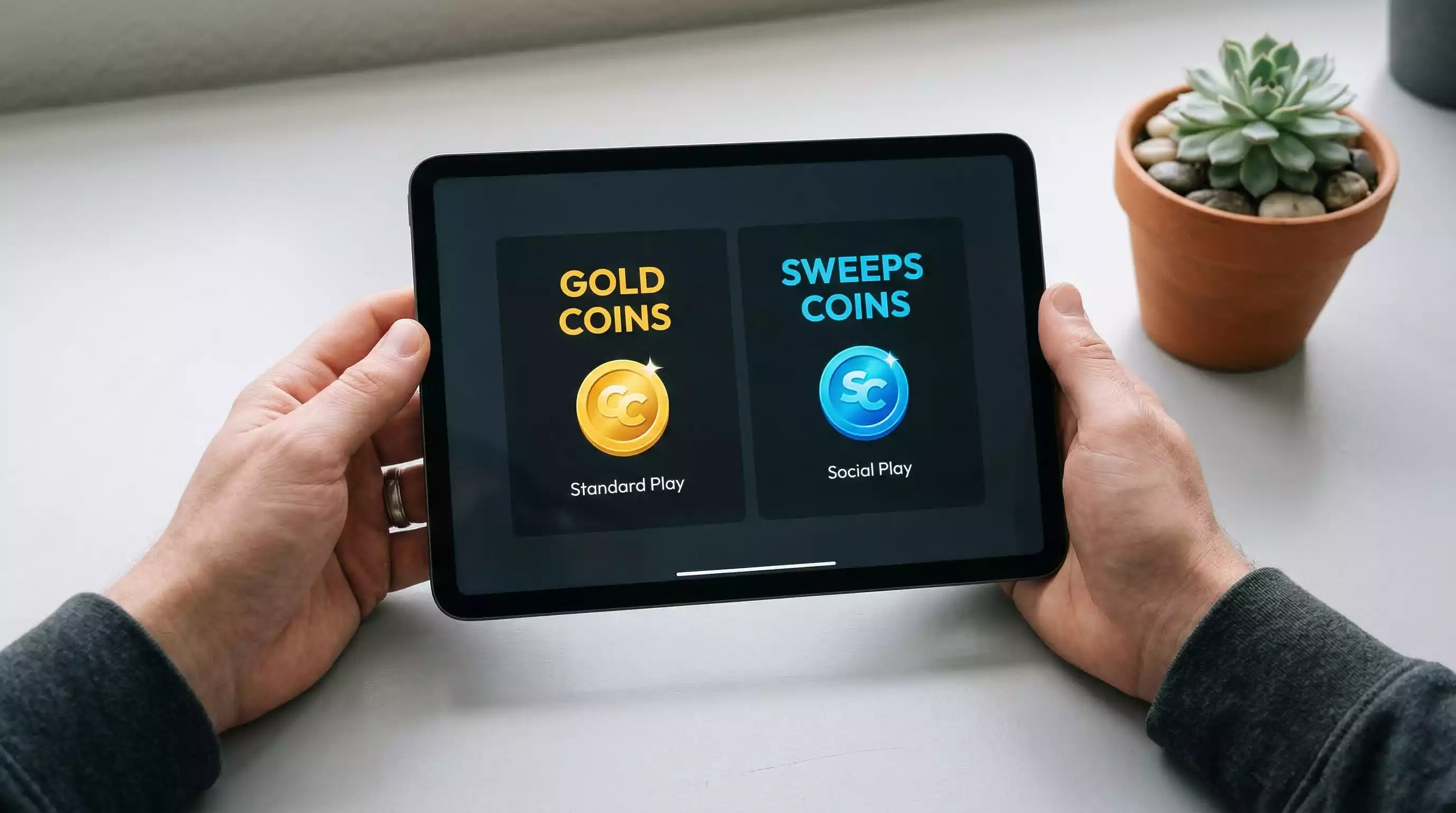
Gold Coins are the primary currency you purchase. They function as entertainment tokens with no cash value whatsoever. You buy a Gold Coin package — say, 10 million GC for $49.99 — and use those coins to play any game on the platform. Win or lose, Gold Coins never convert to real money. They exist to satisfy a legal requirement: what you're buying is a virtual entertainment product, not a gambling stake. This is the "consideration" element that sweepstakes law requires platforms to separate from the prize mechanism.
Sweeps Coins come attached to Gold Coin purchases as a bonus — a free promotional item bundled with your GC package. A typical package might include 10 million Gold Coins and 30 Sweeps Coins for $49.99. Legally, you're paying for the Gold Coins. The SC are a no-cost addition. This framing allows operators to argue that players never "purchase" Sweeps Coins directly, which is critical for maintaining the sweepstakes classification.
The free-entry requirement seals the legal argument. Under federal and most state sweepstakes laws, any legitimate promotion must offer a free method of entry — otherwise it's a lottery, which is illegal without state authorization. Sweepstakes casinos satisfy this through several channels: daily login bonuses that award free SC, social media contests, and the Alternative Method of Entry (AMOE), where players can request free Sweeps Coins by mail. The AMOE option is the most legally significant because it provides a completely purchase-free path to obtaining SC.
In practice, most players obtain Sweeps Coins through purchases rather than free methods. The free-entry channels exist primarily to fulfill the legal obligation, and while daily logins can accumulate SC over time, the amounts are modest compared to what purchase packages deliver. This creates a dynamic where the legal framework emphasizes free access, but the economic model depends almost entirely on paid conversions. Once enough SC are accumulated and playthrough requirements are met (typically 1x), players can redeem at a standard rate of 1 SC = $1 USD — a process detailed in the redemption section below.
How Sweepstakes Casinos Operate
From the outside, a sweepstakes casino looks and feels like any online casino. The lobby has rows of slots, a table games section, maybe live dealer streams. The onboarding flow asks for an email, verifies your age, and drops you into the platform with a welcome bonus. But behind the interface, the operating model is fundamentally different from regulated iGaming — and the numbers reflect that divergence at every level.
The revenue model is straightforward: players buy Gold Coin packages, operators retain the revenue after paying out Sweeps Coin redemptions. There's no house edge in the traditional gambling sense — at least not legally — because Sweeps Coins are classified as promotional prizes, not wagers. In practice, however, the economics work similarly. Players put money in, play games with built-in return-to-player rates, and a percentage of the total volume stays with the operator. The payout structure functions like a casino's hold, even if the legal language avoids that term.
Player acquisition and conversion data reveal how these platforms actually grow. According to Optimove data reported by iGaming Business, sweepstakes casino active player growth hit roughly 16% — three times the growth rate of regulated iGaming platforms. But conversion from free player to first purchase runs at about 12%, compared to 51% for licensed online casinos. That gap tells you something important: sweepstakes platforms attract massive top-of-funnel traffic (much of it through aggressive advertising and social media), but most users never spend money. The ones who do, however, tend to increase their activity sharply — wager frequency roughly triples after the first month of paid play.
This creates a unit economics profile that favors scale over conversion rate. Sweepstakes operators cast a wide net, convert a small fraction, and rely on high engagement from paying users. The absence of licensing fees, gaming taxes, and regulatory compliance costs means margins remain attractive even with lower conversion rates. It's a freemium model applied to casino-style entertainment — and in 2026, it's generating more revenue than the entire regulated iGaming sector.
Types of Games at SC Casinos
The game libraries at sweepstakes casinos have expanded rapidly. What started as slot-heavy platforms with basic titles has evolved into full-featured lobbies covering most categories found at licensed online casinos. The difference isn't the games — it's who provides them, how they're configured, and what transparency players can expect around returns.

Slots
Slots dominate SC casino libraries by volume and player engagement. Most platforms offer several hundred to over a thousand slot titles, sourced from a mix of established providers (Pragmatic Play, NetEnt, Relax Gaming) and smaller studios that develop exclusively for the sweepstakes market. The range spans classic three-reel games to complex video slots with bonus rounds, cascading reels, and progressive features. RTP (return-to-player) configurations vary, and unlike regulated markets, sweepstakes operators are not obligated to disclose RTP figures — a transparency gap that matters for serious players.
Table Games
Virtual table games — blackjack, roulette, baccarat, poker variants — are available at most major SC casinos, though the selection is thinner than slots. The appeal of table games in the sweepstakes context is their inherently higher RTP. A well-played blackjack hand against optimal strategy returns 98–99%, compared to the 94–97% typical of slots. For players focused on maximizing Sweeps Coin value before redemption, table games offer a mathematically superior path, assuming the playthrough requirements don't restrict game eligibility.
Live Dealer
Live dealer games represent the premium tier at sweepstakes casinos. These are real-time streams of actual dealers operating physical tables — blackjack, roulette, baccarat, and game-show-style formats — broadcast from studios. Not all SC platforms offer live dealer options, and availability can vary by state. The technology and licensing costs for live streaming mean this category tends to appear only at the larger, more established platforms. For players, live dealer games bridge the gap between the digital SC experience and the feel of a brick-and-mortar casino.
Crash and Arcade Games
Crash games have emerged as one of the fastest-growing categories in SC casinos. The mechanic is simple: a multiplier climbs from 1x upward, and you cash out before it "crashes." The longer you wait, the higher the payout — but crash too late and you lose everything. Games like Aviator, Spaceman, and various platform-exclusive titles have found a loyal audience, particularly among younger players drawn to the fast-paced, skill-adjacent format. Some crash games implement provably fair algorithms, allowing players to verify the randomness of each round independently.
Fish Games and Scratch Cards
Fish games — shooting-gallery-style titles where players fire at targets to accumulate prizes — incorporate a skill element layered over RNG-based outcomes, attracting players who want something beyond traditional slots. Scratch cards and instant-win games round out the offering with quick, low-commitment gameplay for casual users looking for a break from longer sessions.
Top SC Casinos Compared by Data
Most "best sweepstakes casino" lists are thinly veiled affiliate rankings — the platform paying the highest commission lands the top spot. This section takes a different approach. Instead of subjective ratings, here's what the available financial and operational data actually tells us about the major SC casino operators in 2026.
VGW, the Australian parent company behind Chumba Casino, LuckyLand Slots, and Global Poker, remains the dominant player. According to financial data disclosed through the Cox v. VGW class-action lawsuit and reported by SBC Americas, VGW generated over $4 billion in revenue for fiscal year 2023–24, up from $3.1 billion the prior year, with net profit after taxes of $323.5 million. The company paid out $2.83 billion in sweepstakes prizes, up from $2.2 billion. These are among the only publicly available financial figures for any sweepstakes casino operator, and they paint a picture of a business operating at significant scale.
But VGW's grip on the market is loosening. According to Eilers & Krejcik data cited by Waterhouse VC, VGW's market share dropped from over 90% around 2020 to approximately 50% by 2024, as more than 140 active operators entered the U.S. market. That shift has introduced genuine competition for the first time, with platforms like Stake.us, WOW Vegas, McLuck, Pulsz, and High 5 Casino each carving out significant user bases.
Jonathan Michaels, founder of Michaels Strategies and a vocal advocate for the sweepstakes model, has noted that these operators have been unfairly characterized — they are using established legal mechanisms from the social casino space and adding a prize redemption layer on top. Whether you find that argument convincing depends largely on how you read sweepstakes law, but it captures the industry's self-image: a legal innovation, not a regulatory evasion.
| Platform | Parent Company | Key Currencies | Game Library | Notable Features |
|---|---|---|---|---|
| Chumba Casino | VGW | GC + SC | 500+ | Largest user base, longest track record |
| LuckyLand Slots | VGW | GC + SC | 80+ | Slots-only focus, exclusive titles |
| Stake.us | Medium Rare N.V. | GC + SC | 1,000+ | Crypto-friendly, massive game library |
| WOW Vegas | VGW (separate brand) | WC + SC | 800+ | Aggressive welcome offers, rapid growth |
| McLuck | McLuck Ltd. | GC + SC | 700+ | Strong mobile experience, live dealer |
| Pulsz | Yellow Hat Ltd. | GC + SC | 700+ | Premium game providers, high RTP focus |
| High 5 Casino | High 5 Games | GC + SC | 600+ | Proprietary games, established brand |
A few patterns emerge from the data. First, game library size has become a competitive differentiator — platforms like Stake.us now offer over 1,000 titles, driven by partnerships with dozens of game providers. Second, the VGW ecosystem (Chumba, LuckyLand, WOW Vegas) still commands the largest combined audience, but individual newer platforms are growing faster in percentage terms. Third, the absence of standardized reporting makes true comparison difficult. Unlike regulated casinos, sweepstakes operators don't publish audited financials, payout percentages, or complaint resolution data. The VGW numbers are exceptional only because a lawsuit forced disclosure.
For players choosing a platform, the practical decision comes down to game variety, redemption speed, bonus structure, and state availability. Every platform has different terms, verification timelines, and minimum redemption thresholds — specifics covered in the sections that follow.
Bonuses and Free Sweeps Coins
Bonuses are the primary acquisition tool for sweepstakes casinos, and the spending behind them is staggering. According to AGA research compiled with Sensor Tower data, sweepstakes operators accounted for roughly half of all online casino advertising in early 2025. That advertising spend funnels directly into bonus offers designed to get new players through the door and convert free users into paying customers.
The typical welcome bonus at a sweepstakes casino includes a Gold Coin package with bonus Sweeps Coins at a discounted introductory price. A common structure: pay $9.99 and receive several hundred thousand Gold Coins plus 30–50 SC. Some platforms sweeten the deal with no-purchase-required sign-up bonuses — registering an account nets you a small amount of free SC (usually 2–10) with no payment needed. These no-deposit offers are the closest thing to free money in the SC ecosystem, though the amounts are modest and playthrough requirements apply before any redemption.
Daily Login Rewards
Nearly every sweepstakes casino offers daily login bonuses that award free Gold Coins and small SC amounts for simply visiting the platform. Streak-based systems incentivize consecutive daily logins: miss a day and your streak resets, reducing the cumulative bonus. Over a 30-day cycle, daily logins might accumulate 5–15 SC depending on the platform — not life-changing, but a steady drip of free play that keeps users returning. Some platforms layer escalating rewards on top of the base login bonus, with weekly or monthly milestone payouts.
Referral and Social Bonuses
Referral programs reward existing players for bringing in new users, typically awarding both the referrer and the new player 10–50 SC once registration is complete. Social media promotions supplement this pipeline: platforms run giveaways on Facebook, Instagram, X, and TikTok, distributing free SC through engagement-based contests.
Mail-In Alternative Entry
The Alternative Method of Entry (AMOE) is the least glamorous but most legally significant bonus mechanism. Players can send a physical letter to the operator's designated address requesting free Sweeps Coins. The specifics vary — some platforms require a handwritten request on a 3x5 index card, others accept standard mail — but the principle is the same: a free, no-purchase path to obtaining SC. Response times range from one to three weeks, and the typical award is 2–5 SC per request, with limits on request frequency. The AMOE exists because sweepstakes law demands it, and while few players use it regularly, its presence is what legally distinguishes a sweepstakes promotion from a lottery.
Evaluating Bonus Value
Not all SC bonuses are equal. A 50 SC welcome bonus with 1x playthrough and no game restrictions is worth far more than 100 SC with 3x playthrough limited to specific slots. Read the terms before chasing headline numbers — a lesson that applies to sweepstakes bonuses just as it does to traditional casino promotions.
How Redemption Works: From SC to Cash
The redemption process is where SC casino games turn from entertainment into something that involves real money leaving a company's bank account and entering yours. It's also where the player experience diverges most sharply from traditional online casinos — verification can be slower, minimum thresholds vary widely, and the absence of standardized regulation means each operator sets its own rules.
The basic flow is consistent across platforms. First, accumulate Sweeps Coins through play or bonuses. Second, meet the playthrough requirement — most platforms require 1x wagering. Third, submit a redemption request. Fourth, complete identity verification (KYC), typically requiring government-issued ID, proof of address, and sometimes a selfie. Fifth, receive your payout.

The standard exchange rate across the industry is 1 SC = $1 USD. Minimum redemption thresholds range from 50 SC at some platforms to 100 SC at others — a meaningful difference for casual players building their balance slowly through free entry methods. Maximum daily or weekly redemption caps also apply, though these are typically high enough that only heavy players encounter them.
According to RG.org research, sweepstakes operators pay out approximately 68–72% of total purchases as prizes. That payout rate reflects the aggregate industry average — individual player outcomes vary based on game selection, volatility, and session length. For context, regulated online casinos in markets like New Jersey report theoretical payout rates of 90–95% on slot games, though comparing the figures directly is complicated by the different measurement methodologies.
Processing times represent one of the most common player complaints. Some operators process redemptions within 24–48 hours; others take five to ten business days, particularly for first-time KYC verification. E-wallets like PayPal and Skrill tend to be faster than bank transfers, and a growing number of platforms now offer cryptocurrency payouts that reduce processing times to hours.
The tax treatment of SC redemptions adds another layer of complexity. According to KPMG's sweepstakes industry primer, operators are generally required to issue IRS Form 1099-MISC for prize payouts of $600 or more. However, the question of whether sweepstakes prizes constitute "gambling income" (which would trigger Form W-2G at a $1,200 threshold) or ordinary income remains unresolved. The IRS Technical Advice Memorandum 200417004 addresses this ambiguity, but no definitive ruling exists for the commercial sweepstakes casino context. Players should report all prize income regardless of whether they receive a tax form.
Legal Landscape: Bans, Bills, and Enforcement
The legal environment for sweepstakes casinos changed more in 2025 than in the entire preceding decade. What had been a largely unregulated sector operating on the assumption that sweepstakes law provided sufficient cover suddenly faced a coordinated wave of state-level bans, enforcement actions, and legislative proposals. By early 2026, the industry's legal footing looks fundamentally different from what it did just eighteen months ago.
The central legal question remains the "prize-chance-consideration" test. Under most state gambling laws, an activity constitutes gambling only if it involves all three elements: a prize, an element of chance, and consideration (payment). Sweepstakes casinos argue they eliminate the consideration element by offering free entry through AMOE and daily logins — you never have to pay to obtain Sweeps Coins, so no consideration exists, so it's not gambling. That argument has been sufficient to keep the model alive, but a growing number of regulators and lawmakers have decided it's no longer persuasive.
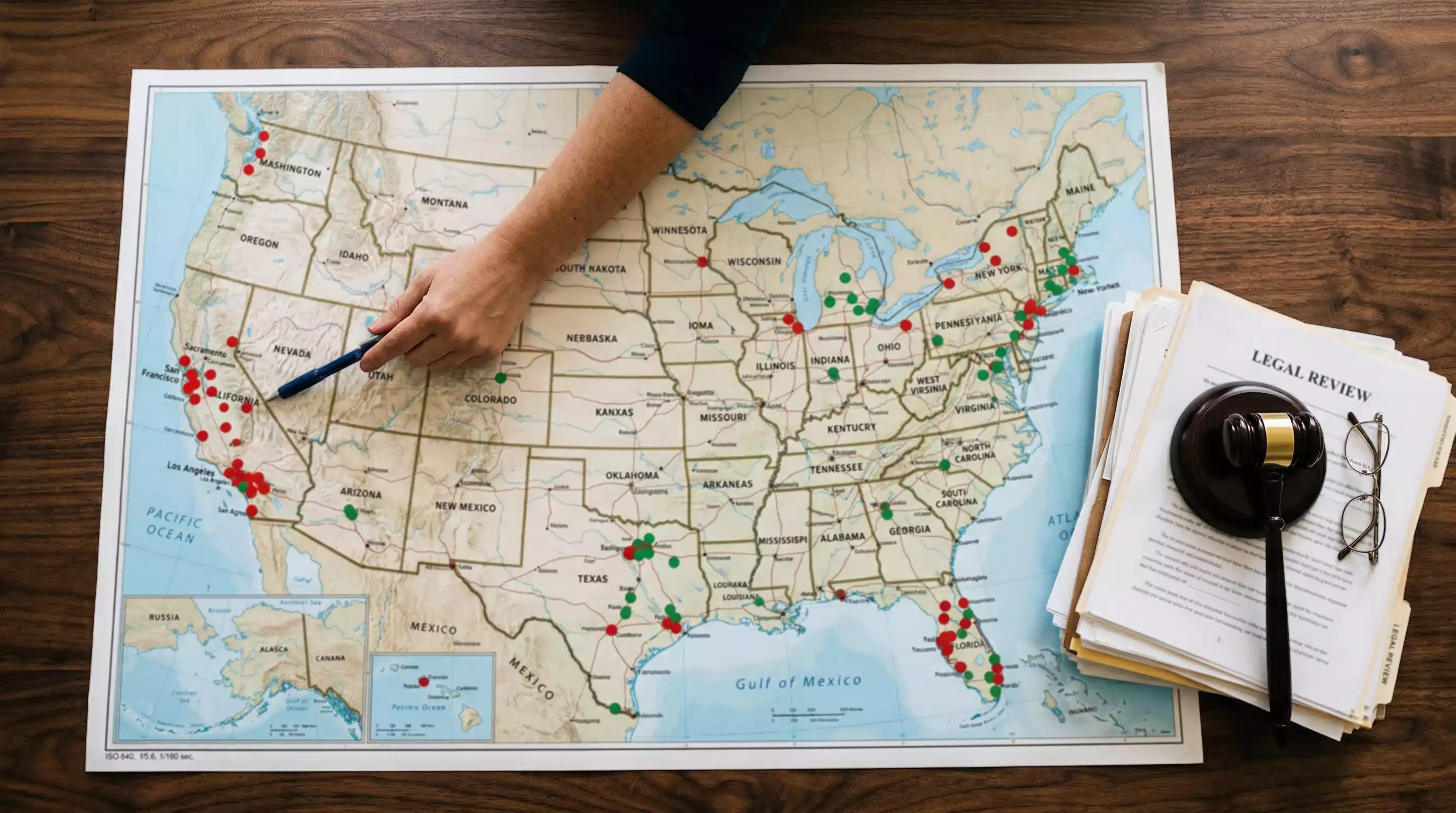
According to iGaming Business's year-in-review analysis, five states enacted laws specifically banning sweepstakes casinos by the end of 2025: Montana (SB 555, May 2025), Connecticut (SB 1235), New Jersey (A5447), California (AB 831, October 2025), and New York (S5935). Additionally, sweepstakes casinos are effectively banned or heavily restricted in Washington, Michigan, Nevada, Idaho, and Louisiana — states with existing gambling frameworks that regulators interpret as covering sweepstakes operations.
The California ban hit hardest. The state represented approximately 20% of the entire sweepstakes industry's revenue, according to Eilers & Krejcik data. AB 831 passed with unanimous support — 79-0 in the Assembly, 36-0 in the Senate — reflecting a rare bipartisan consensus. After the bill was signed, Eilers & Krejcik revised their 2025 industry net revenue projection downward from $4.7 billion to $4 billion. New York's market, estimated at $762 million in annual sales, followed a similar legislative trajectory.
"These operators present themselves like legal, regulated platforms — but they operate outside the law and regulation. There are few if any responsible gaming tools, no regulatory oversight." — Tres York, VP of Government Relations, American Gaming Association. That assessment has driven the AGA's aggressive lobbying campaign against sweepstakes operators, which includes funding research, supporting state legislation, and filing regulatory complaints.
Enforcement actions have intensified alongside the legislative push. According to iGaming Business, regulators in Arizona, Michigan, Maryland, Louisiana, New York, and other states issued more than 100 cease-and-desist letters to sweepstakes operators during 2025. The financial penalties have also escalated. High 5 Games was ordered to pay $24.9 million in damages following a jury verdict in Washington state and agreed to a separate $1.5 million settlement in Connecticut for operating without a license. In September 2025, the Louisiana Department of Revenue filed a $44 million lawsuit against VGW and WOW Vegas for unpaid taxes on virtual currency sales — the first suit of its kind, according to analysis by ZwillGen.
The industry's own response has been split. The Social Gaming Leadership Alliance (SGLA), which represents sweepstakes operators, has publicly called for regulation and taxation. On the other side, the legislative consensus is striking: "Rarely do we agree on anything as lawmakers, but on this issue, we agree that this represents illegal gambling operations." — Shawn Fluharty, WV Delegate, President of NCLGS.
The question for 2026 isn't whether more states will act — that's virtually certain. It's whether operators will secure a regulated framework or whether the ban-and-enforce approach will gradually squeeze them out of their largest markets.
State-by-State Availability Map
Sweepstakes casino availability in the United States is a patchwork that changes with every legislative session. As of early 2026, most states still permit sweepstakes casino operations — either explicitly or through regulatory inaction — but the number of restricted markets has grown significantly.
The states with enacted sweepstakes casino bans are California, New York, New Jersey, Montana, and Connecticut. In addition, Washington, Michigan, Nevada, Idaho, and Louisiana maintain existing legal frameworks that effectively prohibit or severely restrict sweepstakes casino activity. That brings the total number of states with bans or functional restrictions to roughly fourteen, depending on how you classify the legal status in states where enforcement has occurred but specific legislation hasn't been passed.
The revenue distribution reveals why certain bans carry outsized impact. California alone accounted for approximately 20% of the industry's total revenue, and the New York market generated an estimated $762 million in annual sales before S5935 took effect. Florida represents about 8.5% of industry revenue. The concentration of sweepstakes spending in large-population states means that each new ban removes a disproportionate chunk of the market.
An AGA research finding underscores the effect of state-level action: the number of monthly sweepstakes players is roughly twice as high in states without bans compared to states that have enacted restrictions. That data point suggests bans are effective at reducing participation, even though some players inevitably find ways to access platforms through VPNs or by registering with out-of-state addresses.
For players, the practical advice is to verify your state's current status before signing up. Most platforms maintain a list of restricted states and will block registration from those locations. However, the lists can lag behind legislative changes — a platform might still accept registrations from a state that recently passed a ban if the law hasn't taken effect yet. The safest approach is to check both the platform's terms of service and your state's attorney general website for the most current guidance.
Several states are actively considering sweepstakes casino legislation as of 2026, with bills at various stages in Illinois, Ohio, Pennsylvania, and Texas. The trajectory points toward more restrictions, though the specific form — outright bans, regulatory licensing frameworks, or tax-and-operate models — varies by state and by the political dynamics between gaming lobbyists, tribal interests, and consumer protection advocates.
Sweepstakes vs Real-Money Online Casinos
The comparison between sweepstakes casinos and regulated real-money online casinos isn't just an academic exercise — it's the core tension driving the regulatory battle. These two models compete for many of the same players, often with the same games from the same providers, but operate under entirely different legal, financial, and consumer-protection frameworks.
The revenue numbers frame the competition. According to the AGA's State of the States 2025 report, regulated iGaming across seven legal states generated $8.41 billion in 2024 — a 28.7% year-over-year increase. Meanwhile, sweepstakes casinos produced over $10.6 billion in gross revenue across nearly every state. That means an unregulated sector now generates more aggregate revenue than the regulated one. For an industry that has spent decades building a licensed, taxed, audited framework, that comparison is difficult to accept.
The tax gap amplifies the frustration. The AGA's Commercial Gaming Revenue Tracker shows that commercial gaming contributed a record $18.09 billion in tax revenue to state and local governments in 2025 — a 15.1% increase. Sweepstakes casinos contributed zero gaming taxes. They don't hold gaming licenses, so they aren't subject to the tax regimes that apply to licensed operators. The industry's position is that they're running promotions, not gambling operations, and promotions aren't taxed like gaming revenue. State legislators, unsurprisingly, find that distinction less compelling with each passing year.
| Category | Sweepstakes Casinos | Regulated Online Casinos |
|---|---|---|
| Licensing | No gambling license required | State-issued gaming license |
| Availability | Most U.S. states (declining) | 7 states (NJ, PA, MI, WV, CT, DE, RI) |
| Gaming Taxes Paid | None | Varies by state (15–51%) |
| RTP Disclosure | Not required | Required by regulator |
| Regulatory Oversight | Minimal to none | State gaming commission |
| Player Protections | Operator-set policies | Mandated by law |
| Deposit Method | Gold Coin purchases | Direct deposits |
| Payout Verification | No independent audits required | Regular third-party audits |
From a player's perspective, the differences cut both ways. Sweepstakes casinos offer accessibility — play from nearly any state, lower purchase thresholds, faster sign-ups, and free-entry options. Regulated casinos offer stronger protections: dispute resolution through gaming commissions, audited payout rates, mandated responsible gambling tools, and cross-platform self-exclusion programs.
The games themselves are often identical, but the operating conditions around them are not. A Pragmatic Play slot running on a licensed platform in Pennsylvania has its RTP verified and published. The same slot on a sweepstakes platform might be configured differently, with no external verification required. Same product, different oversight — that asymmetry is what makes this debate more than a regulatory technicality.
RTP and Volatility in SC Games
Return-to-player (RTP) and volatility define what your SC gaming sessions will feel like over time. They determine expected losses per dollar played and how much your balance will swing. In regulated markets, these numbers are published and audited. In the sweepstakes space, they're mostly opaque — a problem worth understanding before committing real money to Gold Coin purchases.
RTP represents the theoretical percentage of total wagers returned to players over a very large number of spins or hands. A slot with a 96% RTP returns $96 for every $100 wagered, on average, over millions of rounds. The remaining 4% is the operator's margin. Game providers typically offer their titles in multiple RTP configurations — a single slot might be available at 94%, 96%, or 97%+ RTP. Regulated casinos must disclose which configuration they're running. Sweepstakes casinos are under no such obligation. A player might assume they're getting the headline 96.5% RTP advertised in a game's marketing materials, only to discover the platform selected the lower-return configuration.
Volatility — sometimes called variance — describes the distribution of returns. A low-volatility slot pays out frequently in small amounts, keeping your balance relatively stable. A high-volatility slot pays rarely but in larger chunks, creating dramatic swings. Neither is objectively better; the choice depends on your bankroll, your risk tolerance, and whether you're playing for entertainment or trying to hit a specific redemption threshold. For SC players with small balances, low-to-medium volatility games extend session length and reduce the risk of losing your entire SC balance before reaching the playthrough requirement. High-volatility games are better suited to players with larger SC balances who can absorb dry spells in pursuit of outsized wins.
The transparency gap matters most for serious SC players. If you're redeeming Sweeps Coins for cash, you're functionally operating within a system where returns are governed by RTP settings you can't verify. Some platforms voluntarily submit to third-party audits from firms like eCOGRA or iTech Labs, and if you see those certifications, it's a meaningful signal of fairness. But certification isn't required, and the majority of SC casinos don't display audit results. Until regulation catches up, the practical advice is to favor platforms that provide at least some transparency around game fairness, and to treat any undisclosed RTP as a risk factor rather than an oversight.
Responsible Gambling and SC Casinos
The responsible gambling conversation around sweepstakes casinos is fundamentally different from the one surrounding regulated online casinos — and not in a good way. Licensed operators in states like New Jersey and Michigan are required by law to implement self-exclusion programs, deposit limits, loss limits, session time reminders, and connections to problem gambling resources. Sweepstakes casinos operate with no such mandates. Whatever responsible gambling tools they offer are voluntary, inconsistently implemented, and unaudited.

The data on player behavior makes the gap in protections more concerning. According to AGA research published in July 2025, 68% of sweepstakes casino users report that their primary motivation for playing is to win real money. Additionally, 80% of sweepstakes players spend money on the platforms monthly, with nearly half spending weekly. These aren't casual entertainment users — they're players with financial stakes and gambling-like behavior patterns, accessing platforms that don't provide gambling-level protections.
The broader problem gambling landscape adds context. According to a National Council on Problem Gambling survey conducted with Ipsos, approximately 9 million Americans experience problem gambling, with associated social costs estimated at $14 billion annually. Online gambling participation has grown from 15% in 2018 to 22% in 2024. Sweepstakes casinos, which are accessible in far more states than regulated iGaming and require no gambling license to join, contribute to that expansion of access.
Keith Whyte, then-Executive Director of the NCPG, has characterized sweepstakes operators as exploiting an outdated legal definition of gambling — a position that highlights the gap between how the law classifies these platforms and how players actually experience them. When someone is spending $200 a month buying Gold Coins, receiving Sweeps Coins, playing slot games, and cashing out winnings, the practical experience is gambling regardless of what the legal framework calls it.
Academic research reinforces the concern. A longitudinal study by Dussault et al., published through ResearchGate, found that adolescents who played simulated poker were five times more likely to transition to real-money gambling. While that study focused on simulated gambling broadly, the parallel is direct: platforms replicating the gambling experience without formal classification may normalize gambling behavior, particularly among younger users exposed through social media.
For players, the practical takeaway is straightforward: treat SC casino games with the same discipline you'd apply to any form of gambling. Set a budget, track your spending, and use whatever tools the platform provides. If spending exceeds your entertainment budget or you're chasing losses, the NCPG helpline (1-800-MY-RESET) and state-specific programs offer support. The absence of mandatory protections on these platforms shifts more responsibility onto individual players — an argument for regulation, not against personal caution.
SC Casino Market: Size, Growth, and Projections
The raw numbers behind the SC casino market tell a story of explosive growth meeting sudden regulatory friction. The trajectory over the past four years has been unlike anything else in the American gaming industry — and the next two years will determine whether the sector matures into a regulated business or contracts under legislative pressure.
Start with the baseline. According to KPMG's sweepstakes industry primer, the broader social casino market produced approximately $7.1 billion in gross revenue in 2024, based on Eilers & Krejcik Gaming tracker data. The sweepstakes subsegment — the portion involving Sweeps Coins with real-money redemption — dwarfed that figure, generating over $10.6 billion in gross revenue and $3.4 billion in net revenue during the same period. KPMG places the compound annual growth rate of the sweepstakes segment at 60–70% over the 2020–2024 period, a pace that outstrips virtually every other consumer entertainment category.
The forward projections now carry more uncertainty. KPMG's report projected 2025 gross revenue above $14.3 billion and net revenue above $4.6 billion before regulatory headwinds materialized. But the California ban changed the calculus. Before AB 831, Eilers & Krejcik forecast 2025 net revenue at $4.7 billion. After the bill removed the industry's largest state market, that figure was revised to $4 billion. RG.org's 2026 projections estimate Gold Coin purchases of $12–13 billion and Sweeps Coin redemptions of $8.5–9.5 billion, yielding net revenue of $3.6–4.2 billion.
The demographic profile of the player base has come into sharper focus. According to a Racine County Eye trend report, approximately 58% of sweepstakes casino users fall in the 25–44 age range — younger than the typical brick-and-mortar casino patron but older than the teenage demographic that academic research has flagged as at-risk for gambling transition.
Operator spending on acquisition tells you where the market's momentum comes from. VGW, the industry's largest operator, allocated $275 million to marketing in its most recent fiscal year, up from $237 million the prior year, according to financial data reported by SBC Americas. That level of advertising investment, concentrated heavily on social media and digital channels, drives the massive top-of-funnel player volumes that define the sweepstakes business model. AGA data showing that sweepstakes operators accounted for half of all online casino advertising provides further evidence of the sector's marketing intensity.
The competitive landscape has also shifted dramatically. As detailed in the platform comparison above, VGW no longer dominates the market — more than 140 operators now compete for players, introducing innovation alongside a longer tail of less accountable smaller platforms. What the numbers ultimately reveal is an industry at an inflection point — the growth engine remains powerful, but regulatory headwinds from major-state bans and bipartisan legislative momentum are now material enough to bend the curve. The sweepstakes casino market in 2026 is simultaneously the fastest-growing and the most legally precarious segment of American gaming.
Interactive Tool
VGW Marketing Growth, and iGaming Previous Year
Calculate the exact percentage rise in VGW's marketing spend, and back out regulated iGaming's 2023 revenue from the stated 2024 growth rate.
Percentage Growth
-
-
Prior Year
-
Recent Year
-
Absolute Increase
-
What this guide gives as two figures without the growth rate: "VGW... allocated $275 million to marketing in its most recent fiscal year, up from $237 million the prior year." The percentage growth is never calculated — it's +16.0%, an increase of $38 million.
Implied 2023 Revenue
-
-
2024 Revenue
-
Growth Rate
-
Absolute Increase
-
What this guide states as a growth rate without the base year: "regulated iGaming across seven legal states generated $8.41 billion in 2024 — a 28.7% year-over-year increase." The 2023 figure is never calculated — it works out to roughly $6.53 billion, an increase of $1.88 billion.
Frequently Asked Questions About SC Casino Games
What is the difference between Sweeps Coins and Gold Coins?
Gold Coins (GC) are the entertainment currency — you purchase them to play games, but they carry no cash value. Sweeps Coins (SC) are a promotional currency that arrives as a free bonus alongside Gold Coin purchases or through free-entry methods like daily logins and mail-in requests (AMOE). Only Sweeps Coins can be redeemed for cash, typically at 1 SC = $1 USD after meeting playthrough requirements and identity verification. This dual-currency structure is the legal mechanism that allows sweepstakes casinos to classify themselves as promotional platforms rather than gambling operations.
Can you actually win real money at SC casinos?
Yes. When you play SC games and win, your Sweeps Coin balance increases, and those coins can be redeemed for cash. You'll need to meet a playthrough requirement (usually 1x wagering), reach the minimum redemption threshold (typically 50–100 SC), and pass KYC identity verification. Payouts arrive via bank transfer, PayPal, Skrill, or cryptocurrency. However, industry-wide payout rates run approximately 68–72% of total purchases, meaning the average player redeems less than they spend. The mathematical structure mirrors a casino: some players win, most don't, and the operator retains a margin on aggregate.
How are sweepstakes casinos different from regular online casinos?
The games are often identical — same slots, same providers, same RNG mechanics. The differences are regulatory. Regulated online casinos operate in a handful of licensed states, hold state-issued gambling licenses, pay gaming taxes, undergo regular audits, and must implement responsible gambling protections by law. Sweepstakes casinos operate in most states without gambling licenses, pay no gaming taxes, aren't required to disclose RTP settings, and implement player protections only voluntarily. As of 2026, the regulatory gap is narrowing as more states ban sweepstakes casinos or bring them under existing gambling frameworks.
Our Methodology
This guide was built on a principle that's uncommon in the sweepstakes casino content space: every factual claim should be traceable to a verifiable source. The approach stands in deliberate contrast to the affiliate-driven model that dominates the top search results for SC casino queries, where rankings are determined by commission structures rather than data.
The statistical foundation draws from primary industry sources. Market size and revenue figures are sourced from Eilers & Krejcik Gaming tracker reports as cited in KPMG's 2025 sweepstakes industry primer — the most rigorous publicly available analysis of the sector. Operator financials for VGW come from documents disclosed through the Cox v. VGW class-action litigation and reported by SBC Americas. Regulatory data — state bans, enforcement actions, legislative timelines — is verified against iGaming Business reporting, state gaming commission publications, and legal analyses from firms like ZwillGen. Player behavior and perception data comes from AGA-commissioned research and NCPG surveys.
Expert perspectives are attributed to named individuals with verifiable institutional affiliations. Quotes come from public statements, press releases, conference proceedings, and published interviews. No expert commentary is fabricated, paraphrased as quotation, or presented without source attribution.
Platform comparisons are based on publicly available data as listed on each platform's website. We do not accept compensation from sweepstakes casino operators, and no affiliate links appear in this content. Platform rankings are excluded because any honest ranking would require access to internal data that operators don't publish. This analysis reflects conditions as of early 2026; the landscape changes rapidly, and readers should verify state-specific legal status and platform terms independently.