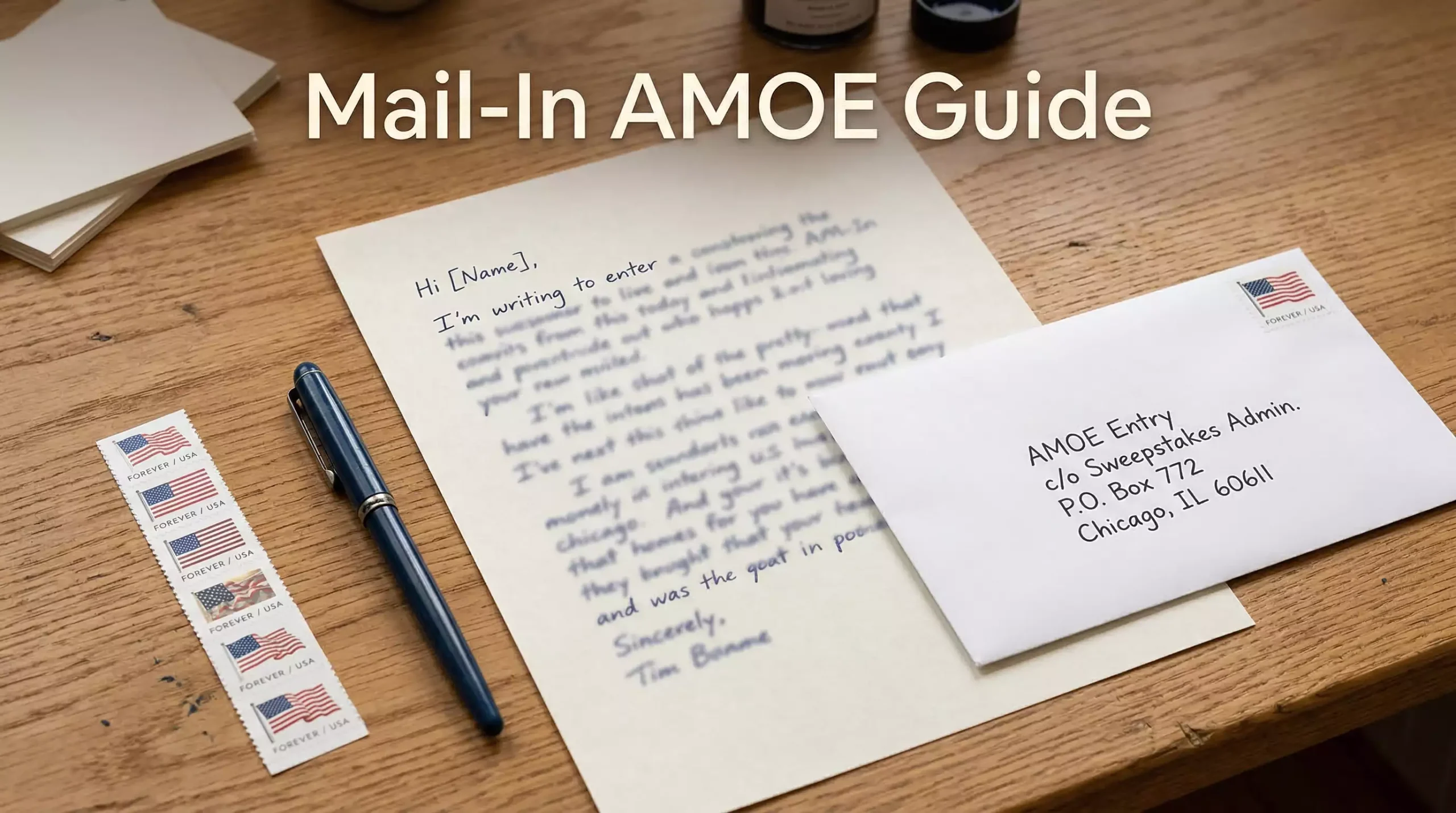
Alternative Method of Entry — AMOE — is the legal bedrock of every sweepstakes casino. Without it, the entire business model collapses. Federal sweepstakes law requires that any promotion offering prizes must provide a free method of entry, ensuring that participants don’t have to pay to play. In the sweepstakes casino context, AMOE takes the form of a postal mail-in request: send a handwritten letter or postcard to the operator, and they credit Sweeps Coins to your account at no cost.
The system sounds anachronistic — and it is. Handwriting a postcard in 2026 to receive virtual currency feels like a regulatory relic. But it’s a functioning one. Players who use AMOE consistently receive real SC that can be wagered on real games and redeemed for real cash, all without making a single purchase. This guide explains why AMOE exists, how to submit a request correctly, and what to expect in terms of response times and SC amounts.
Why Every Sweepstakes Casino Must Offer Free Entry
The legal principle is simple: a sweepstakes that requires payment to enter is not a sweepstakes — it’s a lottery or gambling operation, both of which require a license. The “no purchase necessary” rule is what separates sweepstakes promotions from gambling under federal law. It’s the same principle that puts those tiny disclaimers on McDonald’s Monopoly pieces and Publisher’s Clearing House envelopes. If you have to buy something to participate, the promotion crosses a legal line.
For sweepstakes casinos, AMOE fulfills the no-purchase-necessary requirement. When you buy a Gold Coin package, the Sweeps Coins attached to that purchase are technically a promotional bonus — not something you paid for directly. The mail-in entry provides the same SC through a completely free channel, ensuring that the promotion is legally open to anyone regardless of whether they spend money. Remove AMOE, and the operator can no longer claim that their sweepstakes is free to enter, which means it’s no longer a sweepstakes.
This legal architecture has become increasingly important as states have begun cracking down on the industry. Five states enacted explicit sweepstakes casino bans in 2025, and regulators in multiple additional states have issued cease-and-desist orders. The platforms that survive legal challenges will be those that can demonstrate rigorous compliance with sweepstakes law — and a genuine, functional AMOE program is exhibit A in that argument. Platforms that make AMOE difficult, obscure, or practically useless undermine their own legal defense.
For players in states where sweepstakes casinos are currently accessible, AMOE represents a legitimately free pathway to SC. It’s slower and less convenient than buying a Gold Coin package, but it produces identical SC with identical playthrough terms and identical redemption value. The SC you receive by mail spends and cashes out exactly the same as SC received through any other method.
One critical caveat: AMOE doesn’t override state bans. If your state has prohibited sweepstakes casinos, submitting a mail-in request doesn’t grant you legal access. The operator should reject requests from banned states, and attempting to circumvent a ban through AMOE doesn’t change the legal status of the activity in your jurisdiction.
Step-by-Step: How to Submit a Mail-In AMOE Request
The process is manual, deliberate, and specific. Each platform publishes its AMOE instructions in its terms and conditions or on a dedicated page (usually accessible from the footer under “Sweepstakes Rules” or “Official Rules”). The requirements differ by platform, but the general format is consistent.
First, locate the AMOE address and instructions. Every sweepstakes casino is required to publish this information. Search the platform’s site for “Official Rules,” “Sweepstakes Rules,” or “Alternative Method of Entry.” The page will list a mailing address (typically a PO Box) and the specific information your request must include.
Second, prepare a handwritten request. Most platforms require a physical postcard or a hand-printed card (typically 3.5″ x 5″ or a standard #10 envelope with an index card inside). The request must include: your full legal name (matching your account), your registered email address, your mailing address, and a specific statement such as “I wish to receive Sweeps Coins via Alternative Method of Entry.” Some platforms require your account ID or username as well. Follow the published instructions exactly — deviations can result in the request being voided.
Third, mail the request via USPS. Most platforms specify standard first-class mail. Some explicitly state that requests sent via FedEx, UPS, or other carriers will not be accepted. One stamp, one postcard or envelope, one request per day (or per the frequency limit specified by the platform). The cost is minimal — a first-class stamp runs $0.78 as of early 2026 — but it’s not zero, which occasionally fuels arguments about whether AMOE is truly “free.” Legally, the postage cost is considered de minimis and doesn’t constitute a purchase.
Fourth, wait for processing. After the platform receives your request, it processes the entry and credits SC to your account. You won’t receive a physical reply — the SC simply appears in your balance. Most platforms batch-process AMOE requests on a weekly or biweekly cycle, so expect a delay between sending the postcard and seeing the credit.
Fifth, track your submissions. Keep a simple log: date sent, platform, and date SC received. This helps you verify that requests are being processed and provides documentation if a submission goes missing. If a request isn’t credited within the platform’s stated processing window, contact support with your mailing date and the details you included on the card.
Expected Response Times and SC Amounts
Response times and SC grants vary by platform, and the differences are significant enough to matter for players who plan to use AMOE as a regular SC source.
Processing timelines typically range from 5 to 15 business days after the platform receives your request. Chumba Casino and LuckyLand Slots generally fall in the 7–10 business day range. Newer platforms may take longer — up to 15 business days or more — particularly if they process AMOE manually rather than through an automated intake system. Factor in 2–5 days for USPS delivery and you’re looking at a total turnaround of roughly 1–3 weeks from postmark to SC appearing in your account.
SC amounts per AMOE request are typically modest: 2–5 SC per submission is common at most platforms. Some operators grant amounts equivalent to their smallest purchasable Gold Coin package — if the entry-level package gives 2 SC as a bonus, the AMOE grant is 2 SC. Others offer slightly less. The daily or weekly submission limit further constrains throughput: most platforms allow one AMOE request per day or per stamp, with some capping total submissions at 5–10 per week.
The math on AMOE as a sustained SC source is honest but uninspiring. If a platform allows one request per day, grants 2 SC per request, and processes weekly, a dedicated AMOE user sending 7 postcards per week could accumulate 14 SC per batch — or roughly 56 SC per month. At $0.78 per stamp, the monthly cost is about $21.84 for 56 SC ($56 in potential prize value). That’s a real return on investment, though the effort required — handwriting postcards daily, mailing them consistently, tracking responses — limits the appeal to players who are genuinely committed to the free-entry model.
To put that in context, the sweepstakes industry processed $10 billion in Gold Coin purchases in 2024. AMOE represents a tiny fraction of total SC distributed, but for individual players who use it systematically, it provides a legitimate path to building a redeemable balance without making a single purchase.
Key Takeaway: AMOE is the legally required free entry method that keeps the sweepstakes casino model lawful. Submit a handwritten postcard or card with your account details to the platform’s published address, and they’ll credit SC to your balance within 1–3 weeks. Most platforms grant 2–5 SC per submission, with daily or weekly submission limits. The process is manual and slow, but the SC you receive is identical in value and terms to SC from any other source. For players committed to free play, systematic AMOE submissions can accumulate meaningful SC — but the effort and postage costs mean it’s a supplement, not a primary strategy for most.