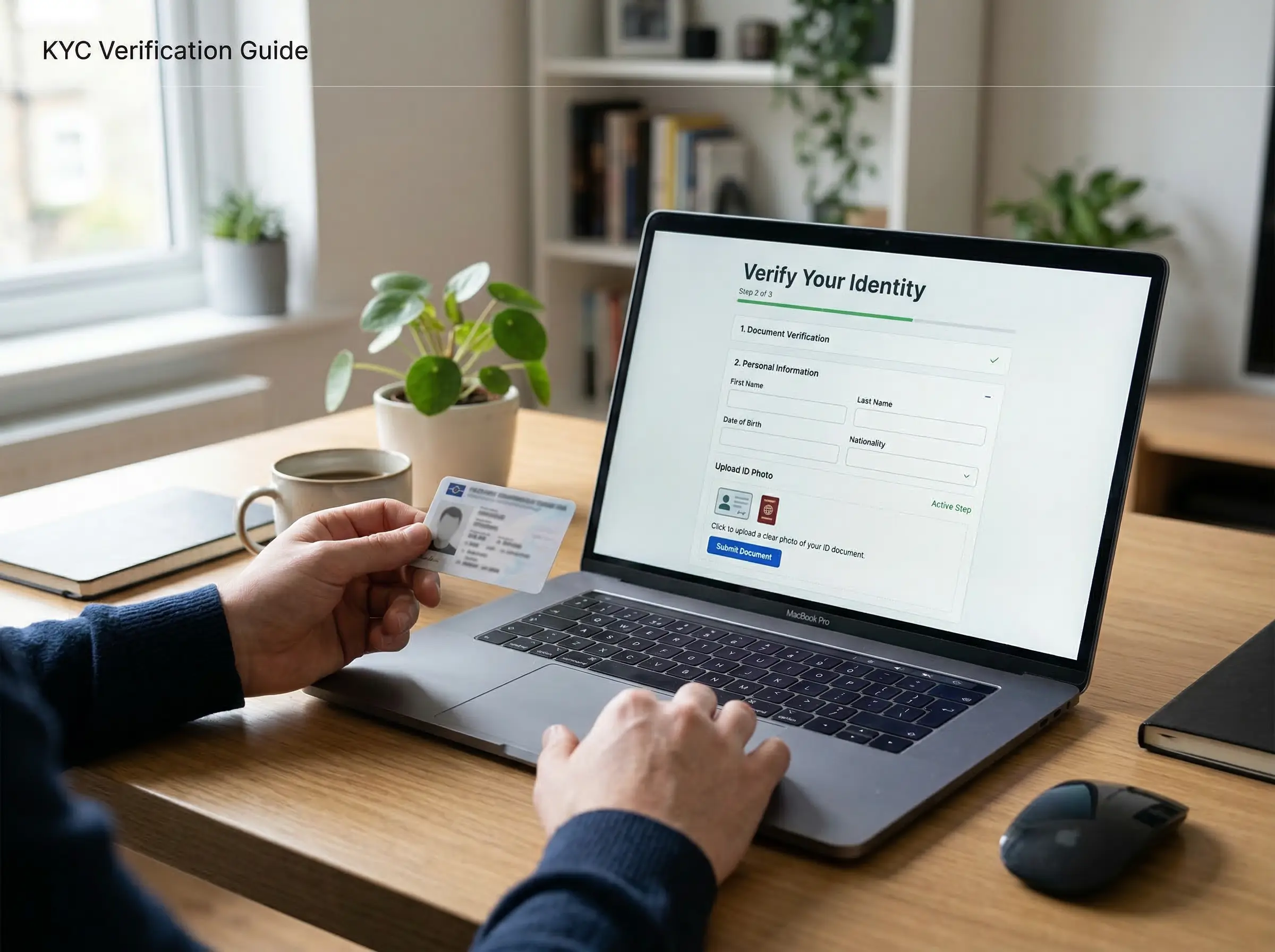
KYC verification is the tollbooth between your Sweeps Coin balance and actual cash. Every sweepstakes casino requires it before processing a redemption, and yet most players don’t think about it until they’re staring at a withdrawal form asking for documents they don’t have handy. The result is predictable: delays, frustration, and support tickets that could have been avoided with 10 minutes of preparation.
Unlike regulated online casinos that verify identity at registration, most sweepstakes platforms let you play indefinitely without proving who you are. You can sign up with an email, buy Gold Coin packages, accumulate Sweeps Coins, and never encounter a verification prompt. The gate drops only when you try to convert SC to cash. At that point, the platform needs to confirm your identity, verify your age and location, and — for tax reporting purposes — match your account to a real person with a valid Social Security Number. This guide covers what documents you need, how the process works at major platforms, and the most common problems that trip players up.
Required Documents for KYC at Sweepstakes Casinos
The document requirements are broadly consistent across platforms, though some operators ask for more than others. Here’s what to have ready before you initiate your first withdrawal.
A government-issued photo ID is the non-negotiable starting point. This means a driver’s license, state-issued ID card, or passport. The document must be current — expired IDs are rejected universally. The name on your ID must match the name on your sweepstakes account exactly. If your account says “Robert” but your license says “Bob,” some platforms will flag the mismatch. If you used a nickname or abbreviation at registration, contact support to correct it before submitting your verification documents.
Proof of address is the second standard requirement. Accepted documents typically include a utility bill (gas, electric, water, internet), a bank or credit card statement, or official government correspondence — all dated within the last 60 to 90 days. The name and address on the document must match your account details. Platforms use proof of address to confirm that you reside in an eligible state, which matters because sweepstakes casinos are restricted in multiple jurisdictions.
A selfie with your ID is increasingly common, particularly among newer platforms and for accounts flagged during automated screening. The platform asks you to take a photograph of yourself holding your ID next to your face. This step verifies that the person submitting the documents is the same person pictured on the ID — a basic anti-fraud measure that prevents account takeover and identity theft. Good lighting and a clear, unobstructed view of both your face and the document are essential.
Some platforms also request partial SSN information — typically the last four digits. This ties directly to tax reporting. Under IRS rules, sweepstakes operators must file a 1099-MISC form for prize payouts exceeding $2,000 in a calendar year (the threshold was raised from $600 effective 2026 under the One Big Beautiful Bill Act), and your SSN is required for that filing. Not every platform asks for this at the KYC stage; some defer it until your cumulative redemptions approach the reporting threshold. Either way, the request is legitimate and tied to a legal obligation.
Prepare all documents before starting the process. Upload them in a single session if possible. Submitting documents piecemeal — one today, another next week — resets the review queue at some platforms and adds unnecessary delays.
The Verification Process: Timelines and What to Expect
Once you submit your documents, the verification process enters a queue. What happens next depends on the platform’s size, its verification infrastructure, and whether your submission triggers any automated flags.
Large-scale operators like VGW — the company behind Chumba Casino and LuckyLand Slots — process tens of thousands of verification requests monthly. VGW’s platforms have paid out over $2.83 billion in sweepstakes prizes in a single fiscal year, which gives a sense of the volume their compliance teams handle. At this scale, automated document scanning does the initial review: OCR reads your ID, cross-references the name and date of birth against your account data, and checks the address against your proof of residence. If everything matches, approval can come within 24 hours. If something gets flagged — a partial mismatch, a low-quality scan, an unusual geographic indicator — your file moves to manual review, which adds 2–5 business days.
Mid-tier operators like Pulsz, High 5 Casino, and Fortune Coins generally process KYC within 48 hours to one week. Their compliance teams are smaller, and manual review is more common even for clean submissions. First-time verifications take the longest because the system has no prior approval to reference.
Newer platforms — those that launched in 2024 or 2025 — may take longer still. Some are still building out their verification pipelines and rely heavily on manual processes. If a new operator takes more than 10 business days to complete KYC without communicating a reason, that’s a red flag worth noting, though it doesn’t necessarily indicate bad faith. Growing pains are real in an industry that added 40+ new operators in a two-year span.
After your first successful verification, subsequent redemptions usually skip the KYC step entirely. Your identity is on file, your documents are validated, and future withdrawal requests go directly to the payment processing stage. Some platforms re-verify periodically — annually or when your ID approaches its expiration date — but these are exceptions rather than the rule.
Common KYC Problems and How to Resolve Them
Most KYC failures come down to a handful of recurring mistakes. Knowing them in advance eliminates the majority of delays.
Name mismatches are the most frequent issue. You registered as “Mike Johnson” but your driver’s license reads “Michael A. Johnson.” Or you got married and changed your last name but never updated your sweepstakes account. The fix is straightforward but requires contacting support: submit a name change request with documentation (marriage certificate, legal name change order) or ask the platform to update your registration details to match your current ID. Do this before submitting KYC documents, not after.
Low-quality document uploads cause the second-largest share of rejections. Photos taken in dim lighting, screenshots of scanned documents with cut-off edges, or images where the text is legible to a human eye but illegible to OCR software all trigger manual review or outright rejection. The solution is simple: photograph your documents on a flat, well-lit surface with all four corners visible. Use a phone camera rather than a webcam. Avoid glare on laminated IDs by angling slightly.
Expired documents get rejected without exception. Check the expiration date on your driver’s license before uploading. If it expires within 30 days, some platforms may flag it preemptively. Renew your ID first, then complete KYC.
Address mismatches — where your proof of address shows a different location than your account registration — can create problems beyond simple verification. If your account was registered in a state that has since banned sweepstakes casinos, or if your proof of address places you in a restricted state, the platform may freeze your account pending resolution. Players who have moved states should update their account address and submit new proof of address reflecting their current location.
Tax-related complications emerge at the redemption stage rather than during KYC itself, but they’re closely linked. Under guidance analyzed by KPMG in their sweepstakes industry primer, operators issue IRS Form 1099-MISC for cumulative prize payouts exceeding $2,000 in a calendar year (raised from $600 effective 2026). Your KYC data — name, address, SSN — feeds directly into that filing. If your KYC information is inaccurate, your tax form may arrive with errors, creating headaches at filing time. Getting KYC right isn’t just about accessing your money; it’s about making sure the IRS paperwork matches reality.
If your KYC gets rejected and you’re unsure why, contact the platform’s support team with a specific request: ask which document was rejected and the exact reason for rejection. Generic responses like “verification failed” aren’t helpful, and you’re entitled to know what needs to be corrected. Escalate if the first response doesn’t provide actionable detail.
Key Takeaway: KYC verification is a one-time hurdle that unlocks every future redemption — but only if you get it right the first time. Prepare a current government ID, recent proof of address, and be ready for a selfie request. Make sure the name on every document matches your account registration exactly. Submit everything in one session, use high-quality photos, and consider completing verification early with a small test withdrawal rather than waiting until a large balance is at stake. Once approved, subsequent cashouts move faster and bypass the identity check entirely.