
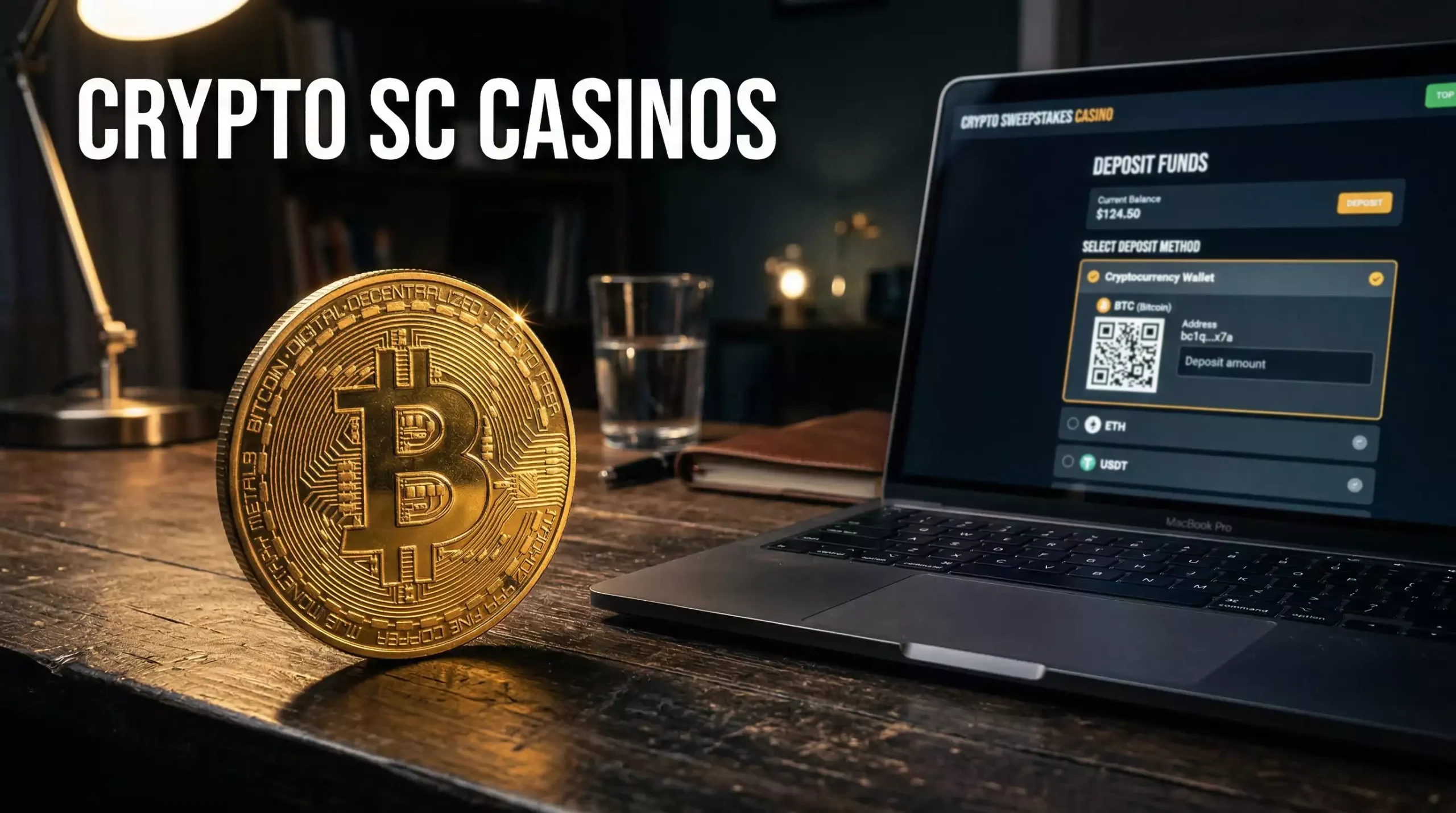
Cryptocurrency has carved out a meaningful niche in the sweepstakes casino market. A growing number of platforms accept Bitcoin, Ethereum, Litecoin, and stablecoins for Gold Coin purchases, and some offer crypto as a payout method for Sweeps Coin redemptions. For players who already hold crypto, this integration removes the friction of converting to fiat before buying into a platform. For the industry, it opens a payment channel that processes faster than bank transfers and operates outside the traditional card-processing ecosystem.
But crypto at sweepstakes casinos isn’t a simple plug-and-play experience. The mechanics of how deposits convert to Gold Coins, which coins each platform supports, and how crypto payouts interact with tax reporting all require understanding before you connect a wallet. This guide covers the practical details of using cryptocurrency at sweepstakes casinos — from deposit flow to supported coins to the specific advantages and risks that come with choosing crypto over traditional payment methods.
How Crypto Deposits Work at Sweepstakes Casinos
The deposit mechanics for crypto at sweepstakes casinos follow the same fundamental model as fiat purchases: you’re buying Gold Coins, and Sweeps Coins arrive as a promotional bonus. The difference is the payment method used to complete that purchase. Instead of entering a credit card number, you send cryptocurrency from your wallet to an address provided by the platform.
The typical flow works like this. You select a Gold Coin package on the platform’s purchase page, choose cryptocurrency as your payment method, and the platform generates a deposit address (usually a QR code and alphanumeric string) specific to the transaction. You send the equivalent USD value in crypto from your wallet to that address. Once the transaction receives the required number of blockchain confirmations — typically 1–3 for Bitcoin, near-instant for Litecoin and stablecoins — the Gold Coins and bonus Sweeps Coins are credited to your account.
The exchange rate applied at the moment of transaction is important. Most platforms use a third-party payment processor (like CoinsPaid, NOWPayments, or BitPay) to convert the incoming crypto to USD at the prevailing market rate. The Gold Coin package you selected is priced in USD, so the amount of crypto you send depends on the current exchange rate. This means the cost of a $9.99 Gold Coin package fluctuates in BTC terms — a minor detail for stablecoin users but a meaningful one for Bitcoin or Ethereum holders dealing with price volatility.
The sweepstakes industry generated $10 billion in purchases in 2024, according to Eilers & Krejcik Gaming. While the crypto share of that figure isn’t publicly broken out, the adoption of crypto payment options across multiple platforms indicates it’s a non-trivial channel. Platforms wouldn’t invest in integrating crypto processors if the demand weren’t there.
Processing times vary by blockchain. Bitcoin deposits typically confirm within 10–60 minutes depending on network congestion. Litecoin is faster — usually under 5 minutes. Ethereum confirmation times range from a few seconds to a few minutes. Stablecoins like USDT (Tether) on the Tron or Ethereum network offer the most predictable experience: near-instant confirmation with no price volatility between sending and crediting. For players who want crypto’s speed without its price risk, stablecoins are the practical choice.
Supported Cryptocurrencies by Platform
The range of supported cryptocurrencies differs substantially from one sweepstakes casino to another. Some platforms accept only Bitcoin. Others support a broad menu of coins including altcoins and stablecoins. Here’s where the major players stand.
Stake.us is the most crypto-forward sweepstakes casino. Built by the same team behind Stake.com (one of the world’s largest crypto gambling platforms), Stake.us supports Bitcoin, Ethereum, Litecoin, Dogecoin, and multiple stablecoins including USDT and USDC. Crypto isn’t just an option at Stake.us — it’s the primary payment method, and the platform’s user interface reflects that with wallet-native features that feel familiar to anyone who’s used a decentralized exchange.
WOW Vegas accepts Bitcoin and Litecoin for Gold Coin purchases, with crypto payouts available for SC redemptions. The integration is functional but less extensive than Stake.us — fewer supported coins, and the checkout experience is designed primarily for fiat users with crypto as an alternative.
Pulsz has added cryptocurrency support across a handful of coins, typically Bitcoin and Ethereum, with additional options depending on the payment processor they use at any given time. The supported coin list has expanded over the past year as Pulsz has invested in broadening its payment infrastructure.
Chumba Casino and LuckyLand Slots, operated by VGW, do not currently support cryptocurrency deposits or withdrawals. VGW’s platforms rely on traditional payment methods — credit/debit cards, ACH bank transfers, PayPal, and Skrill. Given VGW’s size and compliance-heavy approach, the absence of crypto likely reflects a deliberate choice around regulatory risk rather than a technical limitation.
Newer platforms vary widely. Some launch with crypto support from day one, recognizing that it lowers payment processing costs and attracts a specific player demographic. Others add crypto months after launch as their payment infrastructure matures. If crypto is important to your experience, verify support before creating an account — and check whether both deposits and withdrawals are available, since some platforms accept crypto in but only pay out in fiat.
Advantages and Risks of Crypto at SC Casinos
Crypto offers several concrete advantages over traditional payment methods at sweepstakes casinos, but it also introduces risks that fiat users don’t face.
Speed is the most tangible advantage. Crypto deposits confirm in minutes (or seconds for stablecoins and Litecoin), compared to hours for card payments that require fraud screening and days for ACH bank transfers. On the withdrawal side, crypto redemptions — where available — often process faster than any fiat method because they bypass banking intermediaries entirely. For players who value fast access to funds, crypto is the most efficient option.
Privacy is a partial advantage. Crypto transactions don’t require sharing bank account details or credit card numbers with the platform. You’re sending from one wallet address to another. However, this privacy is limited: sweepstakes casinos still require KYC verification before processing withdrawals, so the platform knows your identity regardless of how you fund your account. Crypto provides payment-level privacy, not account-level anonymity.
Lower processing costs can translate to better package value at some platforms. Card transactions carry processing fees of 2–3% that platforms either absorb or pass through in pricing. Crypto transaction fees are generally lower, especially on networks like Litecoin or Tron. Some platforms offer slightly more favorable coin package ratios for crypto purchases, though this isn’t universal.
The primary risk is price volatility. If you buy Bitcoin to deposit at a sweepstakes casino and Bitcoin’s price drops 5% while the transaction confirms, you’ve effectively paid more for the same Gold Coin package. This risk is eliminated by using stablecoins (USDT, USDC), which maintain a 1:1 peg with the US dollar. For volatile coins like BTC or ETH, the risk is real and should be factored into your cost calculations.
Tax complexity is the second major risk. Cryptocurrency transactions create potential taxable events under IRS rules. When you spend Bitcoin to buy Gold Coins, you may owe capital gains tax on any appreciation in the BTC you spent — in addition to the income tax obligations on any Sweeps Coin winnings. As outlined in KPMG’s sweepstakes industry analysis, operators are required to issue IRS Form 1099-MISC for SC prize payouts exceeding $600. The crypto layer adds a second reporting dimension that fiat players don’t need to worry about. Players using crypto at sweepstakes casinos should keep detailed records of every deposit and withdrawal for tax purposes — including the market value of the crypto at the time of each transaction.
Finally, irreversibility is inherent to blockchain transactions. If you send crypto to the wrong address or select the wrong network, the funds are gone. There’s no bank to call, no chargeback to file. Double-check wallet addresses and network selections before confirming any transaction. Most platforms display a warning about this, but the responsibility is entirely on the sender.
Key Takeaway: Crypto integration at sweepstakes casinos offers faster deposits, quicker withdrawals, and lower processing costs — but introduces price volatility and added tax complexity. Stake.us leads the space with the broadest coin support, while VGW’s platforms (Chumba, LuckyLand) don’t accept crypto at all. Stablecoins like USDT eliminate volatility risk and are the most practical choice for players who want crypto’s speed without its price swings. If you use volatile coins, factor the exchange rate risk into your effective purchase cost. And regardless of which coin you use, keep detailed transaction records — the IRS treats both your crypto appreciation and your SC winnings as taxable events.
Crypto Sweepstakes Casinos — More on this topic at sc casino games.
See also Best Sweepstakes Casino Table Games.