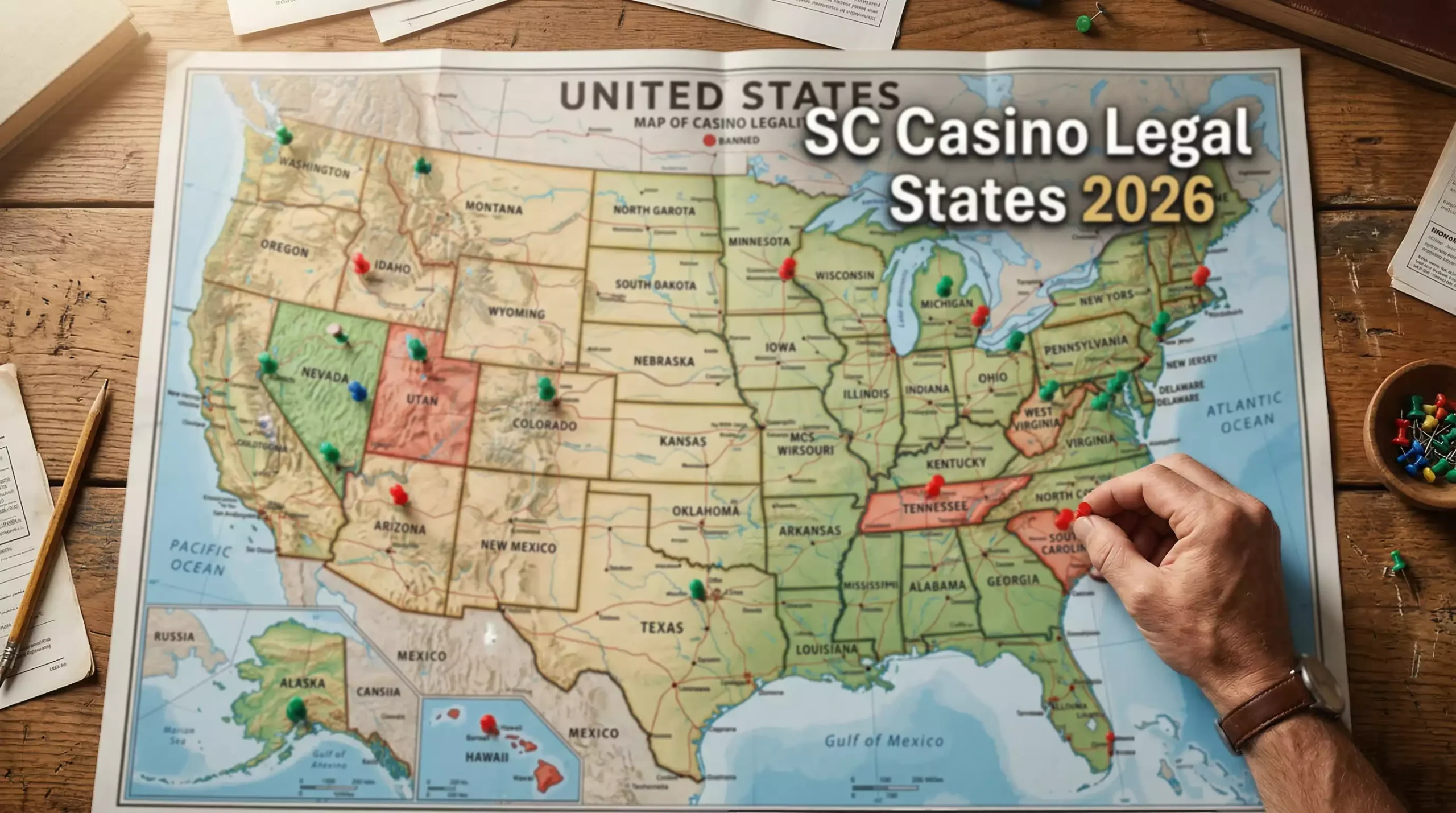
Sweepstakes casinos operate in most of the United States, but “most” is doing heavy lifting in that sentence. As of early 2026, five states have enacted explicit ban laws targeting sweepstakes casino operations, and at least four more effectively prohibit them through existing gambling statutes or aggressive enforcement actions. The map changed dramatically in 2025, when a wave of legislative activity — driven by lobbying from the regulated gaming industry and mounting concerns over consumer protection — redrew the lines of access for millions of players.
What makes the landscape confusing is that sweepstakes casinos have never been explicitly legalized anywhere. They operate under a legal theory — the sweepstakes promotional model — that positions them outside the traditional definition of gambling. States that ban them aren’t revoking a license; they’re closing what they consider a loophole. States that allow them aren’t endorsing them; they simply haven’t acted against them yet. This article maps the current status by state, details the bans that took effect in 2025, and identifies the legislative activity that could reshape access further in 2026.
State-by-State Sweepstakes Casino Status
The simplest way to categorize the 50 states is into three tiers: states with explicit bans, states with effective prohibitions through enforcement or existing law, and states where sweepstakes casinos currently operate without legal challenge.
States with explicit ban laws enacted in 2025 include Montana (SB 555, signed May 2025), Connecticut (SB 1235), New Jersey (A5447), California (AB 831, signed October 2025), and New York (S5935). These are legislative bans — each state passed a specific bill targeting sweepstakes casino operations. The details vary (some ban the sale of virtual currency used for sweepstakes play; others reclassify sweepstakes platforms as illegal gambling), but the outcome is the same: operators must cease service to residents of these states or face legal consequences.
States with effective bans through existing statutes or enforcement include Washington, Michigan, Nevada, Idaho, and Louisiana. Washington state has long treated sweepstakes casinos as illegal gambling under its broadly written gambling code, and High 5 Games learned that lesson at a cost of $24.9 million in fines. Nevada prohibits unlicensed gambling operations categorically. Idaho’s gambling laws are among the most restrictive in the country. Michigan, home to multiple regulated iGaming operators, has taken enforcement action against sweepstakes sites operating within its borders. Louisiana’s Department of Revenue filed a $44 million lawsuit against VGW and WOW Vegas in 2025 over unpaid taxes on virtual currency sales.
The revenue stakes are enormous. According to data from Eilers & Krejcik Gaming presented at the Global Gaming Expo, California alone accounted for roughly 20% of all sweepstakes industry revenue, New York generated $762 million in platform sales in 2024, and Florida represented approximately 8.5% of the total market. When California and New York enacted their bans, the industry lost access to its two largest state markets in a matter of months.
The remaining states — roughly 35 to 40 depending on how you count borderline cases — currently permit sweepstakes casino access by default. No state has passed legislation explicitly authorizing or regulating sweepstakes casinos. The platforms operate in these states because no law specifically prohibits them and no enforcement action has challenged them. That permissive status can change with a single bill, executive order, or attorney general opinion, which is why the “legal” label applied to sweepstakes casinos always comes with an asterisk.
2025 Bans: Montana, Connecticut, New Jersey, California, New York
The 2025 legislative session was the most consequential year in sweepstakes casino history. Five states moved from passive tolerance to active prohibition, and the speed at which bills advanced caught many in the industry off guard.
Montana led the charge. SB 555, signed into law in May 2025, classified sweepstakes casino operations as illegal gambling under state law. Montana’s move was partly driven by concerns from its brick-and-mortar gaming establishments — the state has one of the highest per-capita concentrations of video gambling machines in the country, and operators viewed unregulated sweepstakes platforms as a direct threat to their licensed revenue.
Connecticut and New Jersey followed with their own bills. Both states host regulated iGaming markets and saw sweepstakes casinos as unlicensed competitors siphoning revenue that would otherwise flow through taxed channels. High 5 Games had already paid a $1.5 million fine in Connecticut before the ban formalized, suggesting the legislative action was less about discovery than about codifying a position the state had already taken through enforcement.
California’s AB 831, signed by Governor Newsom in October 2025, was the single largest market closure in the industry’s history. The bill passed unanimously in both chambers — 36-0 in the Senate, with no opposition votes in the Assembly. The Social Gaming Leadership Alliance estimated that California’s sweepstakes market was worth roughly $1 billion annually in economic activity. Following the ban, Eilers & Krejcik revised their 2025 industry net revenue forecast downward from $4.7 billion to $4 billion — a $700 million haircut from a single state.
New York’s S5935 completed the wave. As Shawn Fluharty, West Virginia Delegate and president of the National Council of Legislators from Gaming States, stated at the NCLGS Winter Conference: “Rarely do we agree on anything as lawmakers, but on this issue, we agree that this represents illegal gambling operations.” That kind of cross-aisle consensus is rare in any policy area, and it signals that the legislative momentum against sweepstakes casinos extends well beyond individual states with competing iGaming interests.
The enforcement backdrop reinforced the legislative push. Throughout 2025, state regulators issued over 100 cease-and-desist letters to sweepstakes operators across Arizona, Michigan, Maryland, Louisiana, New York, and other states. These letters don’t carry the force of law, but they establish a paper trail that makes subsequent legal action — fines, injunctions, criminal referrals — significantly easier for state attorneys general to pursue.
Pending Legislation and What to Watch in 2026
The 2025 ban wave didn’t exhaust legislative appetite. Several states entered 2026 with active bills or committee discussions targeting sweepstakes casinos, and the pattern suggests the total number of restricted states will continue growing.
States with pending or expected legislative action include Ohio, Pennsylvania, Illinois, and Georgia. Ohio’s gaming commission has publicly flagged sweepstakes internet cafes — a related but distinct model — as a persistent enforcement challenge, and broadening the scope to include online sweepstakes casinos would be a natural extension. Pennsylvania, like Connecticut and New Jersey, operates a mature regulated iGaming market with multiple licensed operators who have lobbied aggressively against unregulated competition. Illinois has seen draft language circulating in committee that would define sweepstakes casino virtual currency as a gambling instrument.
On the other side of the debate, the Social Gaming Leadership Alliance has called for regulation rather than prohibition. SGLA member companies argue that a regulated, taxed framework would allow states to capture revenue, impose consumer protections, and maintain an industry that serves tens of millions of players in states without legal iGaming. Whether any state takes that approach — regulation instead of a ban — remains to be seen, but the argument has gained traction in states that don’t host competing commercial casino interests.
The wildcard is federal action. Multiple members of Congress have referenced sweepstakes casinos in hearings on online gambling and consumer protection, though no federal bill specifically targeting the model has advanced beyond committee. If federal legislation emerges, it would supersede the patchwork of state-level bans and create a unified regulatory framework. That outcome remains unlikely in the near term, but the probability is no longer zero.
For players, the practical implication is straightforward: check your state’s status before signing up, and check again periodically. The map that was accurate in January 2025 was already outdated by December. The map in this article reflects conditions as of early 2026, but legislative sessions move fast, and a single bill can shift a state from accessible to banned within months.
Key Takeaway: Sweepstakes casinos operate in roughly 35–40 US states by default — not because those states have legalized them, but because no law explicitly prohibits them yet. Five states enacted bans in 2025, and at least four more enforce effective prohibitions through existing statutes. California and New York — the industry’s two largest markets — are now closed, with measurable impact on operator revenue forecasts. More bans are likely in 2026 as states with regulated iGaming markets continue to push back against unlicensed competition. Always verify your state’s current status before creating an account or attempting a redemption.