
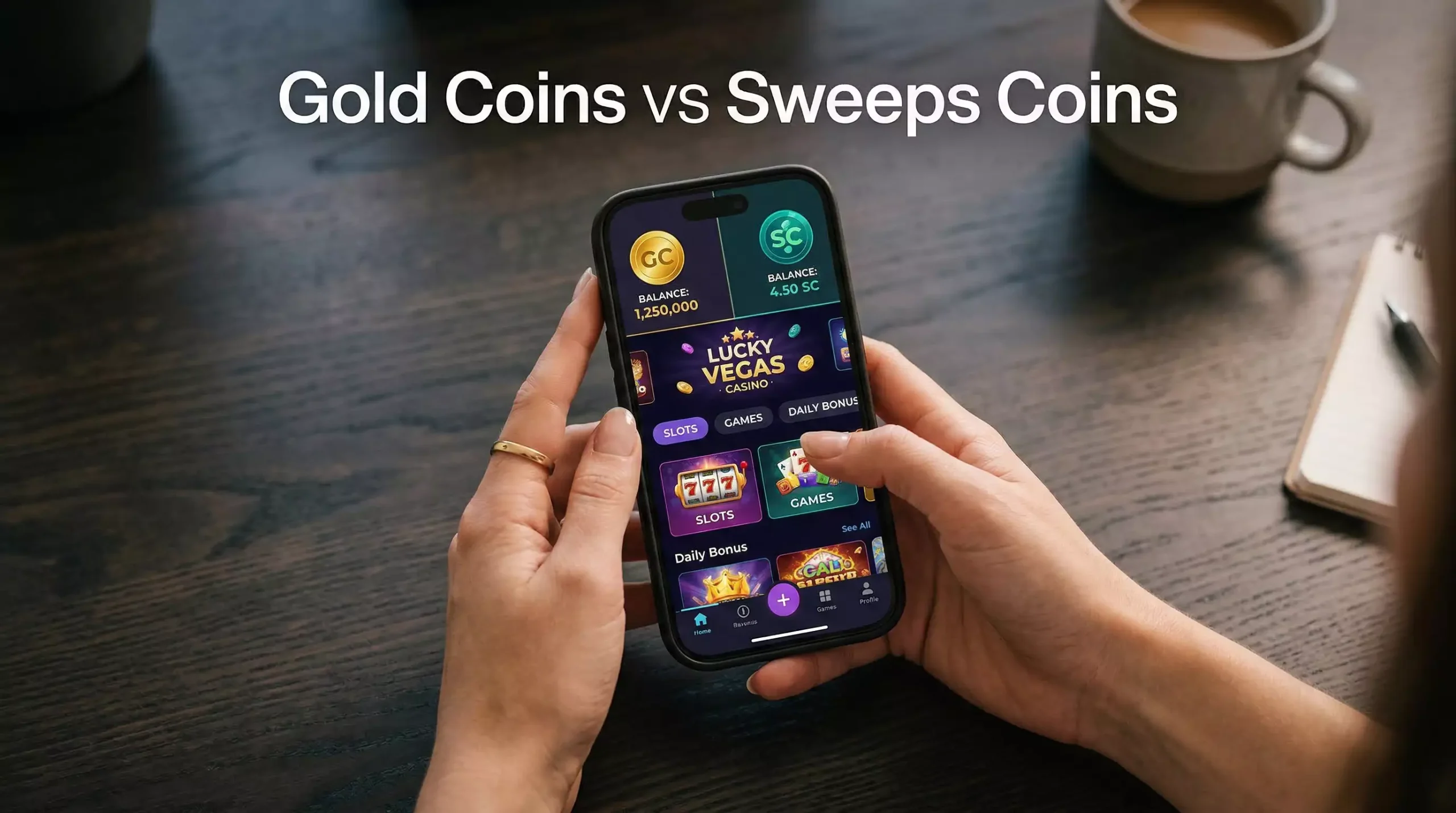
Every sweepstakes casino runs on two currencies, and confusing them is one of the most common mistakes new players make. Gold Coins and Sweeps Coins look similar on screen, sometimes sit in adjacent balance counters, and both get used at the same tables and slot reels. But they serve fundamentally different purposes, carry different monetary values, and follow separate rules for how they enter and exit your account.
Understanding this dual-currency model is not optional if you plan to redeem anything. Gold Coins are essentially play money — purchased directly, used for entertainment, and never convertible to cash. Sweeps Coins, on the other hand, function as the prize-eligible currency that can eventually be redeemed for real money. The distinction sounds simple until you realize that buying Gold Coins is the primary way most players acquire Sweeps Coins, and that the ratio between the two varies wildly from platform to platform. What follows is a breakdown of how each currency works, what determines their value, and where the exchange rates actually stand across major sweepstakes casinos in 2026.
Gold Coins: The Play-for-Fun Currency
Gold Coins are the baseline currency at every sweepstakes casino. They carry no monetary value, cannot be withdrawn, and exist purely to keep the gameplay loop spinning. Think of them as arcade tokens — you can feed them into any machine on the floor, but you’re not walking out with cash regardless of what the screen says you’ve won.
Players get Gold Coins in several ways. Most platforms hand out a generous batch at registration — anywhere from 10,000 to several million GC depending on the operator. Daily login bonuses, social media promotions, and mail-in alternative method of entry (AMOE) requests replenish the supply for free. But the primary source for most active players is purchasing GC packages directly with real money. This is the economic engine of the entire sweepstakes model: when you buy a Gold Coin package, you’re technically buying virtual entertainment currency. The Sweeps Coins that come bundled with that purchase are classified as a promotional bonus — a free add-on, not a product you paid for.
That legal framing matters enormously. Because Gold Coins are the item being sold, the transaction looks like a standard virtual goods purchase rather than a gambling deposit. It’s the same logic that lets mobile game developers sell in-app currency without running afoul of gambling statutes. The difference is that sweepstakes casinos attach a second currency with real-world redemption potential.
On the gameplay side, Gold Coins function identically to Sweeps Coins. They access the same slots, the same table games, the same crash and fish titles. RTPs and volatility profiles don’t change based on which currency you’re wagering. This design is intentional — it ensures that free players experience the same product as paying players, which reinforces the legal argument that no purchase is necessary to participate. According to RG.org’s analysis of operator financials, sweepstakes platforms pay out roughly 68–72% of sales as prizes through the SC channel. Gold Coins, by contrast, produce zero outgoing value. Every GC wagered stays within the system, making the play-for-fun currency the more profitable side of the ledger for operators — even though most players barely notice it.
One practical detail worth remembering: Gold Coin balances are usually enormous compared to Sweeps Coin balances. If your account shows 250,000 GC and 25 SC, that’s entirely normal. The numbers are scaled differently because GC exists to create the psychological experience of high-stakes play without any financial consequence.
Sweeps Coins: The Currency That Converts to Cash
Sweeps Coins are where the real action is. Unlike Gold Coins, SC carry actual monetary value and can be redeemed for cash prizes once you’ve met the platform’s minimum threshold and completed identity verification. The typical redemption rate is 1 SC = $1 USD, though some platforms use slightly different naming conventions and ratios. Stake.us, for example, uses “Stake Cash” at a similar 1:1 conversion. Crown Coins, used by certain newer operators, follow their own scale.
How do you get Sweeps Coins? There are three primary channels. The first — and by far the most common — is through Gold Coin purchases. When you buy a $9.99 GC package, the platform might include 3 SC as a free bonus. You didn’t buy those Sweeps Coins. You received them as a promotional incentive alongside your Gold Coin purchase. This is the structural backbone of the entire sweepstakes model, and it’s the mechanism that generated $10 billion in purchases across the industry in 2024, according to research by Eilers & Krejcik Gaming for the Social Gaming Leadership Alliance.
The second channel is free entry methods. Federal sweepstakes law requires that participants have a way to enter without making a purchase — the “no purchase necessary” principle. Most platforms satisfy this through AMOE mail-in requests (send a handwritten postcard, receive SC by mail) and through daily login bonuses that drip small amounts of SC into your account every 24 hours. Social media giveaways, referral bonuses, and promotional events also distribute SC at no cost.
The third channel is winnings. When you wager Sweeps Coins on a slot spin or blackjack hand and win, those winnings arrive in SC. This creates a compounding cycle: SC purchased indirectly through GC packages gets wagered, potentially multiplied, and eventually becomes eligible for cash redemption. The playthrough requirements — typically 1x the SC amount — must be met before withdrawal, but that bar is dramatically lower than what traditional online casinos impose on bonus funds.
One important nuance: not all Sweeps Coins are immediately redeemable. Most platforms distinguish between “bonus SC” and “prize SC.” The SC you receive from a purchase or free entry are bonus SC, subject to playthrough. Once wagered and won back, they convert to prize SC, which sits in your redeemable balance. This two-tier system trips up more players than almost any other mechanic, especially when their total SC balance looks healthy but their redeemable SC shows a fraction of that number.
Coin Values and Exchange Rates Across Platforms
If there’s one area where sweepstakes casinos diverge from each other most visibly, it’s in how they price their coin packages and how many SC come bundled per dollar spent. The exchange rates aren’t standardized. There is no industry body dictating that $10 must yield a specific number of Sweeps Coins, and operators exploit that flexibility aggressively.
At Chumba Casino, the longest-running major platform, a typical package might offer 2 million GC plus 20 SC for $10. That’s a cost of roughly $0.50 per Sweeps Coin. WOW Vegas tends to run higher GC numbers with comparable SC bonuses, while newer platforms like McLuck and Zula Casino sometimes offer more favorable SC ratios as part of acquisition-stage promotions designed to pull users away from established operators. Some platforms tier their pricing so that larger purchases yield proportionally more SC per dollar — a $100 package might offer 2x or 3x the SC-per-dollar ratio of a $4.99 entry-level package.
The redemption side is more consistent. Nearly every major platform redeems SC at a 1:1 ratio with USD, meaning 50 redeemable SC equals a $50 cash prize. Minimum redemption thresholds vary — Chumba requires 100 SC minimum, while some platforms drop as low as 10 SC or even 5 SC. Processing times range from 1–3 business days for established operators to over a week for newer platforms still building out their payment infrastructure.
Where this gets interesting is in the effective value calculation. If you spend $10 and receive 20 SC, and you then wager those 20 SC on games with a platform payout rate of approximately 70%, your expected return before redemption is around 14 SC, or $14 in potential prize value. Subtract the original $10, and the expected net value of those Sweeps Coins is roughly $4. That’s a simplified model — variance in slot outcomes means any individual session could return more or less — but it illustrates why understanding the GC-to-SC ratio at the point of purchase matters. A platform that gives you 30 SC for $10 instead of 20 SC has effectively increased your expected value by 50%, assuming identical payout rates.
Some operators have introduced alternative naming conventions that obscure direct comparison. Stake.us uses “Gold Coins” and “Stake Cash.” Fortune Coins uses “Fortune Coins” and “Sweeps.” Regardless of branding, the underlying structure remains the same: one currency is for play, the other is for prizes. Before committing to a platform, compare the actual SC-per-dollar ratio at the package tier you plan to buy most often. The headline “get 10 million Gold Coins!” is marketing noise. The SC count attached to that package is the number that determines your real-money exposure.
Key Takeaway: Gold Coins and Sweeps Coins coexist in every sweepstakes casino, but they serve entirely different roles. GC is entertainment currency — bought directly, used freely, never redeemable. SC is prize currency — received as a bonus or through free entry, wagered on the same games, and eventually convertible to real cash at a 1:1 rate. The critical variable is the SC-per-dollar ratio in each platform’s coin packages, which directly determines your real-money upside. Always check how many Sweeps Coins a package includes before focusing on the Gold Coin number. The GC figure is cosmetic. The SC figure is what matters.
Gold Coins vs Sweeps Coins — More on this topic at sc casino games.
See also How to Redeem Sweeps Coins for Cash.