
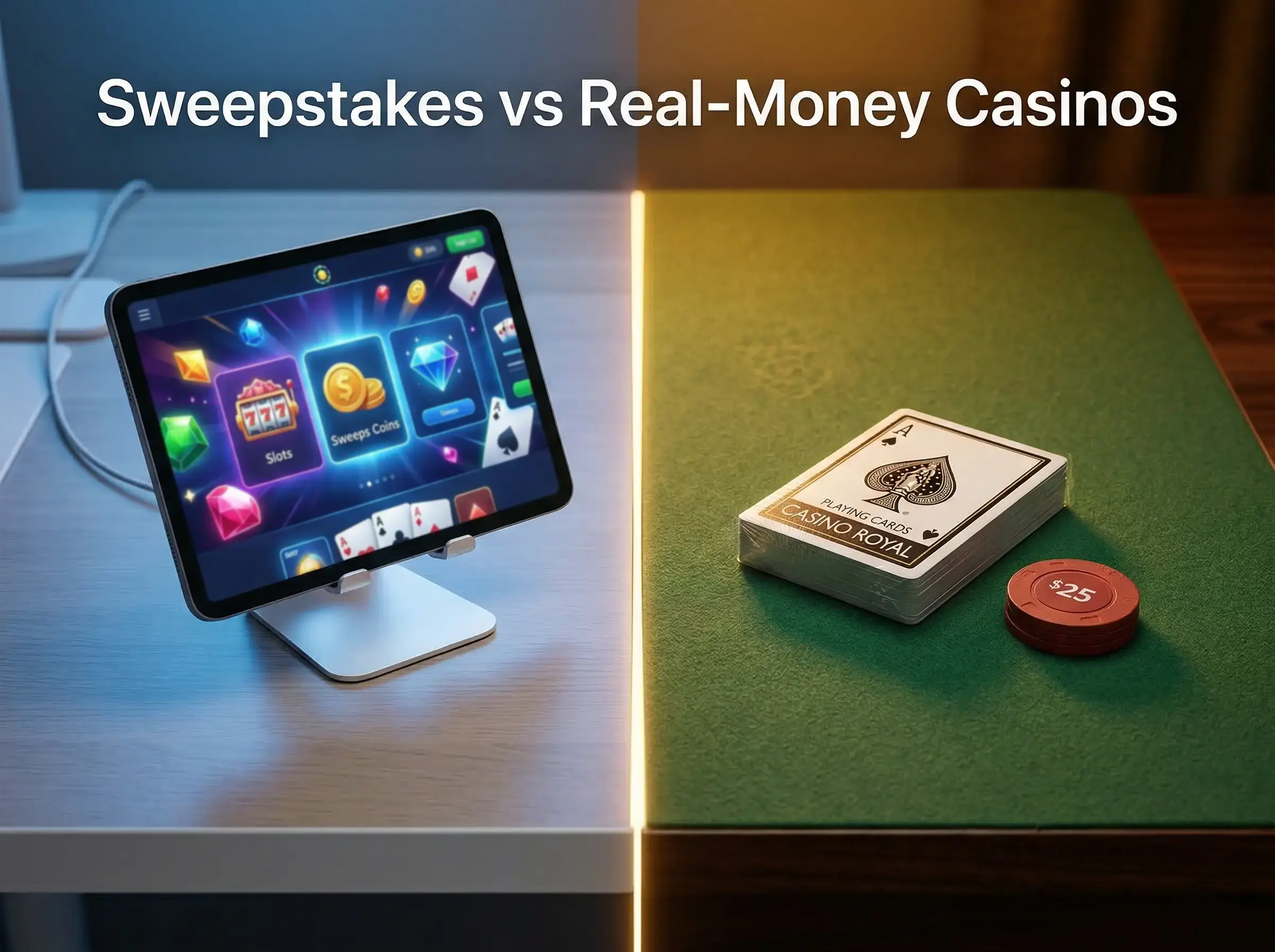
In 2024, sweepstakes casinos surpassed regulated iGaming in total revenue for the first time. Regulated online casinos, operating in just seven U.S. states, generated $8.41 billion — a strong 28.7% year-over-year increase by any measure. Sweepstakes casinos, operating in the majority of states without gambling licenses, pulled in over $10.6 billion in gross revenue over the same period. That crossover point transformed what had been a niche alternative into a direct competitor to the licensed gambling industry — and set off a sweepstakes vs real-money comparison that regulators, operators, and players can no longer avoid.
The two models serve overlapping audiences with similar products — online slot machines, table games, and live dealer experiences — but they operate under fundamentally different rules. One is licensed, taxed, audited, and restricted to a handful of states. The other is self-regulated, untaxed, unaudited in most jurisdictions, and available almost everywhere. The games often come from the same providers. The player experience can feel nearly identical. But the legal framework, the financial protections, and the transparency standards diverge in ways that affect every dollar a player spends or wins.
This sweepstakes vs real-money comparison covers the structural differences across five dimensions: how the business models generate revenue, what the player experience looks like on each side, how regulation shapes protections and limitations, where the revenue numbers stand and where they’re heading, and how players should evaluate which model fits their situation. The data tells a story that’s more nuanced than either industry wants to admit.
Business Models: How Money Flows Differently
The revenue mechanics of sweepstakes and real-money casinos appear similar on the surface — players put money in, play games, and some of it comes back. But the underlying structures are different in ways that affect margins, regulatory costs, and player protections.
A licensed online casino operates as a straightforward gambling business. Players deposit real money, wager it on games, and withdraw winnings. The operator’s revenue is gross gaming revenue (GGR) — total wagers minus total payouts. In 2025, the U.S. commercial gaming industry generated a record $78.72 billion across all segments, according to the AGA Commercial Gaming Revenue Tracker. The iGaming slice — online casinos and poker in seven licensed states — contributed $8.41 billion of that total. These operators hold state-issued licenses, pay gaming taxes ranging from 15% to over 50% of GGR depending on the jurisdiction, submit to regular audits, and comply with responsible gaming mandates.
Sweepstakes casinos route the same basic economic activity through a different legal structure. Players purchase Gold Coins — a virtual currency with no cash value — and receive Sweeps Coins as a free promotional bonus. The SC can be played and redeemed for cash prizes. Gross revenue for the sweepstakes sector exceeded $10.6 billion in 2024, with net revenue (after prize payouts) of approximately $3.4 billion, per Eilers & Krejcik data published in a KPMG primer. Operators pay no gaming taxes, hold no gambling licenses, and face no mandatory audit requirements in most states. The virtual currency wrapper is what enables the entire model — it transforms what would be gambling transactions into purchases of entertainment products with a promotional sweepstakes attached.
The margin structure reflects this difference. Licensed casinos return 85–97% of wagers to players (depending on game type), but they pay 15–50% of the remaining GGR as gaming tax, plus regulatory compliance costs. Sweepstakes casinos return 68–72% of purchases as redeemed prizes — a lower payout rate — but they keep the remainder without gaming tax deductions. The lower payout rate and zero tax burden combine to produce competitive or even superior margins, despite the sweepstakes model’s lower first-purchase conversion rate.
This structural asymmetry is the core tension between the two industries. Bill Miller, President and CEO of the American Gaming Association, has framed it in stark terms, saying that these operations exploit consumer confusion and threaten to undermine the public trust that the regulated industry has built over many years. That perspective reflects the view from licensed operators who see sweepstakes casinos as free-riding competitors — offering a functionally identical product without bearing the costs of licensing, taxation, and regulatory compliance.
The sweepstakes industry’s counter-argument is that their model is legally distinct, not a competitor gaming business operating in disguise. They sell virtual coins. They give away Sweeps Coins as promotions. They don’t offer gambling. The legal debate continues, but the financial reality is undeniable: the two sectors now compete for the same players, often with the same games, and the money flows are large enough to attract serious attention from both regulators and investors.
The Player Experience: Access, Games, and Payouts
For a player sitting at a laptop deciding where to play, the most immediate difference between sweepstakes and real-money casinos is access. Licensed online casinos operate in seven states: New Jersey, Pennsylvania, Michigan, West Virginia, Connecticut, Delaware, and Rhode Island. If you don’t live in one of those states, legal real-money iGaming isn’t available to you. Sweepstakes casinos, by contrast, are accessible in the majority of U.S. states — the exceptions being the five with outright bans and a few others with enforcement-driven restrictions. For the roughly 200 million Americans in states without legal iGaming, sweepstakes casinos are the only online option that offers casino-style games with real-money redemption potential.
The game catalogs overlap significantly. Both sectors draw content from the same pool of B2B game providers — Pragmatic Play, NetEnt, Hacksaw Gaming, Relax Gaming, Evolution. A player at a New Jersey online casino might spin Gates of Olympus from Pragmatic Play on Wednesday; a player at a sweepstakes casino in Texas could play the identical game on Thursday. The mechanics, visual design, and sound are the same. The math model underneath may differ — sweepstakes operators can select different RTP configurations — but the surface-level experience is indistinguishable.
The registration process diverges substantially. Licensed casinos require identity verification upfront — government-issued ID, Social Security number, and proof of address — before a player can deposit or play. This is a regulatory requirement designed to prevent underage gambling, verify player identity for tax reporting, and enable self-exclusion programs. Sweepstakes casinos, by contrast, allow registration with minimal information — typically just a name, email, date of birth, and state — with KYC verification deferred until the player attempts to redeem Sweeps Coins. That low-friction onboarding is a significant acquisition advantage but means identity verification happens after the player has been engaged, not before.
The payout experience is where the two models diverge most consequentially. At a licensed casino, a player can withdraw any portion of their balance at any time (subject to pending wagering requirements on bonuses). Withdrawal options typically include bank transfer, e-wallets, and sometimes check. Processing times run 24 to 72 hours at most established platforms. The operator is required by regulation to process withdrawals within a defined timeframe.
At a sweepstakes casino, payout involves redeeming Sweeps Coins — and the experience is less standardized. Minimum redemption thresholds (50–100 SC), first-time KYC verification delays, and variable processing times (24 hours to 10+ business days) create a longer and less predictable path from balance to bank account. According to industry data tracked by RG.org, the aggregate payout rate across sweepstakes platforms sits at roughly 68–72% of purchases — meaning players collectively receive back about two-thirds to three-quarters of what they spend. At licensed casinos, aggregate payout rates are higher (typically 85–95% depending on game mix), reflecting the regulated requirement for player-favorable RTP configurations and the competitive pressure of a more mature market.
The bottom line for players is a trade-off between accessibility and protections. Sweepstakes casinos are available to far more people and offer an easy on-ramp with no ID verification until redemption. Licensed casinos provide stronger payout guarantees, transparent RTP, mandatory responsible gaming tools, and regulatory recourse if something goes wrong. The games are often the same; everything around them is different.
Regulatory Oversight: Licensed vs Unregulated
The regulatory gap between sweepstakes and real-money casinos isn’t subtle — it’s a chasm. Licensed iGaming operators in states like New Jersey and Pennsylvania operate under some of the most rigorous gambling regulations in the world. Sweepstakes casinos, in most states, operate under none.
Start with RTP transparency. Licensed casinos are required to deploy games at RTP configurations that meet state minimums (often 83% or higher) and to disclose those configurations to regulators. Many states also require that aggregate payout data be publicly reported. Sweepstakes casinos face no RTP disclosure requirements. An operator can deploy a slot at 94% RTP or 97% RTP, and the player has no right to know which one is running. Some platforms voluntarily disclose; most don’t.
Game fairness is another area of divergence. Licensed casinos must have their Random Number Generators tested and certified by independent third-party labs — eCOGRA, GLI, BMM Testlabs, or iTech Labs — on a regular basis. Those certifications are maintained as a condition of the gaming license. Sweepstakes casinos may submit to voluntary testing, and some do, but there’s no regulatory mandate. Players are trusting the operator’s claim of fairness rather than an independently verified standard.
Responsible gaming protections are mandated by regulation in every licensed iGaming state. Operators must provide deposit limits, loss limits, session time limits, reality checks, self-exclusion options, and links to problem gambling resources. Multi-state self-exclusion databases (like GameSense and the NCPG’s national helpline) are integrated into licensed platforms. Sweepstakes casinos may offer some of these tools — particularly the larger operators — but implementation is voluntary and inconsistent. There’s no regulatory body checking whether a sweepstakes platform’s responsible gaming tools actually function, and no enforcement mechanism if they don’t.
The tax dimension is where the regulatory disparity has the broadest public policy impact. According to the AGA Commercial Gaming Revenue Tracker, licensed gaming generated $18.09 billion in tax revenue during 2025 — a record that funded state budgets, education programs, and infrastructure projects across the country. Sweepstakes casinos, generating comparable revenue in aggregate, contributed zero in gaming taxes. That gap represents billions in unrealized public revenue and is, not coincidentally, the single most powerful argument motivating state legislators to act against the sweepstakes model.
Consumer recourse is the final regulatory difference worth highlighting. If a player at a licensed casino experiences a game malfunction, a disputed payout, or an unfair account closure, they can file a complaint with the state gaming commission — a regulatory body with the authority to investigate, penalize the operator, and order remedies. If a player at a sweepstakes casino has the same experience, their options are limited to contacting the operator’s customer support, posting on social media, or pursuing legal action privately. There is no gaming commission overseeing the transaction, no regulatory standard the operator must meet, and no public accountability mechanism short of the court system.
None of this means that every licensed casino delivers a perfect experience or that every sweepstakes casino operates in bad faith. But the structural difference in oversight creates a fundamentally different risk profile for players. At a licensed platform, regulatory infrastructure exists to catch and correct problems. At a sweepstakes platform, the player is largely on their own.
Revenue Face-Off: Sweepstakes Surpass iGaming
The revenue comparison between sweepstakes and regulated iGaming tells a story of asymmetric growth. Licensed online casinos have been expanding steadily — iGaming revenue grew 28.7% year over year to reach $8.41 billion in 2024, according to the AGA’s State of the States report. That growth rate is impressive by any standard and reflects the ongoing maturation of legal markets in states like New Jersey, Pennsylvania, and Michigan.
Sweepstakes casinos have been growing faster. Much faster. The sector’s compound annual growth rate between 2020 and 2024 was 60–70%, according to KPMG’s industry analysis. In 2024, gross revenue exceeded $10.6 billion — surpassing regulated iGaming for the first time. Net revenue, after prize payouts, came in at approximately $3.4 billion, with projections of $14.3 billion gross and $4.6 billion net for 2025 before the California ban forced a downward revision to roughly $4 billion net.
Several structural factors explain why sweepstakes revenue has grown so rapidly. First, geographic reach. iGaming operates in seven states; sweepstakes casinos operate in 40+ states. The addressable population is roughly ten times larger. Second, acquisition friction. Licensed casinos require full identity verification before a player can start. Sweepstakes casinos let anyone sign up with an email and play immediately. Third, marketing intensity. With 50% of all online casino advertising now coming from sweepstakes operators, the sector has achieved a level of consumer awareness that took regulated iGaming years to build.
The growth trajectory has limits, though. The five state bans enacted in 2025 removed significant revenue — California alone represented 20% of the market. If additional large states follow suit, the geographic advantage shrinks. Regulatory costs, should any state choose to regulate rather than ban, would also compress margins. And the industry’s reliance on a legal model that courts haven’t definitively upheld creates an ever-present tail risk: a single unfavorable federal ruling could restructure the entire sector overnight.
From the iGaming perspective, the sweepstakes surge has been both a competitive threat and a growth catalyst. The AGA has lobbied aggressively for sweepstakes regulation, framing the issue as one of consumer protection and fair competition. But the underlying dynamic has also accelerated the push for iGaming legalization in new states — if legislators are going to crack down on sweepstakes, offering a regulated alternative becomes politically easier. States like New York, Illinois, and Indiana are all in various stages of iGaming legalization debates, partly motivated by the desire to capture revenue currently flowing to unregulated operators.
The revenue crossover in 2024 was a landmark moment, but the numbers alone don’t capture the full picture. iGaming revenue is generated within a regulated framework that includes taxation, consumer protections, and a sustainable relationship with state governments. Sweepstakes revenue is generated outside that framework, which makes it simultaneously more profitable for operators and more precarious as a long-term business. The question isn’t just which model generates more revenue — it’s which model can sustain that revenue as the regulatory environment continues to evolve.
Choosing Between Sweepstakes and Real-Money Casinos
The choice between a sweepstakes casino and a licensed real-money casino depends on three variables: where you live, what you prioritize as a player, and how much regulatory protection you want around your money.
If you live in one of the seven states with legal iGaming — New Jersey, Pennsylvania, Michigan, West Virginia, Connecticut, Delaware, or Rhode Island — you have access to both options. In that case, the decision comes down to trade-offs. Licensed casinos offer higher aggregate payout rates, mandatory RTP disclosure, independent game auditing, regulatory complaint mechanisms, and responsible gaming tools that are required by law. Sweepstakes casinos offer a broader selection of platforms (there are over 140 active SC operators versus a handful of licensed brands per state), lower entry friction, and bonus structures that don’t carry traditional wagering requirements. Some players maintain accounts at both, using licensed platforms for their primary play and sweepstakes casinos for their bonus offers and alternative game selection.
If you live in one of the 30+ states without legal iGaming, sweepstakes casinos are effectively the only option for casino-style online play with real redemption potential. The absence of a regulated alternative makes the sweepstakes model’s deficiencies — RTP opacity, voluntary responsible gaming tools, uneven payout timelines — more consequential, because there’s no licensed benchmark to compare against. In these states, players should approach sweepstakes casinos with extra diligence: research the platform’s reputation, check for voluntary RNG certification, test the payout process with a small redemption before committing significant funds, and use whatever responsible gaming tools are available.
For players in states with sweepstakes bans — California, New York, New Jersey, Connecticut, Montana, and states with active enforcement — the choice is made for you. Licensed iGaming (where available) is the legal path; sweepstakes casinos are not. Attempting to access a sweepstakes platform from a banned state via VPN or location spoofing risks account closure, forfeiture of balances, and potential legal consequences.
The financial dimension matters too. Players with larger bankrolls and longer time horizons benefit more from the regulated model’s higher payout rates and loss-deduction tax treatment. Casual players looking to try casino games without a significant financial commitment may find the sweepstakes model’s free entry methods and low-cost welcome packages more appropriate as a starting point.
Ultimately, the two models will likely converge as regulation catches up with the sweepstakes sector and iGaming expands to more states. Several states currently debating iGaming legalization are doing so partly in response to the sweepstakes industry — the argument being that if residents are already playing casino games online through unregulated channels, creating a regulated alternative captures tax revenue and adds consumer protections. For players, that trajectory means more options and better protections over time. But in 2026, the two models remain meaningfully different products operating under meaningfully different rules — and the informed player is the one who understands exactly what those differences mean for their money, their data, and their legal standing.
Key Takeaway: Sweepstakes and real-money casinos now compete directly for U.S. players, often with the same games from the same providers, but the similarities end at the surface. Licensed casinos operate within a regulatory framework that mandates RTP disclosure, game fairness auditing, responsible gaming tools, and gaming tax contributions that totaled $18 billion in 2025. Sweepstakes casinos operate outside that framework — no gaming taxes, no mandatory RTP transparency, no regulatory recourse for players. The sweepstakes sector’s gross revenue surpassed iGaming’s in 2024, driven by a massive geographic advantage (40+ states vs. seven) and aggressive marketing that now accounts for half of all online casino advertising. But that revenue exists on increasingly unstable legal ground: five state bans, 100+ enforcement actions, and growing legislative momentum suggest the unregulated window is narrowing. For players, the choice between the two models is ultimately about what you’re willing to trade — broader access and easier entry against stronger protections and more transparent gameplay. Both models deliver real casino experiences. Only one comes with a regulatory safety net.
Sweepstakes vs Real-Money Casinos — More on this topic at sc casino games.
See also Gold Coins vs Sweeps Coins.