
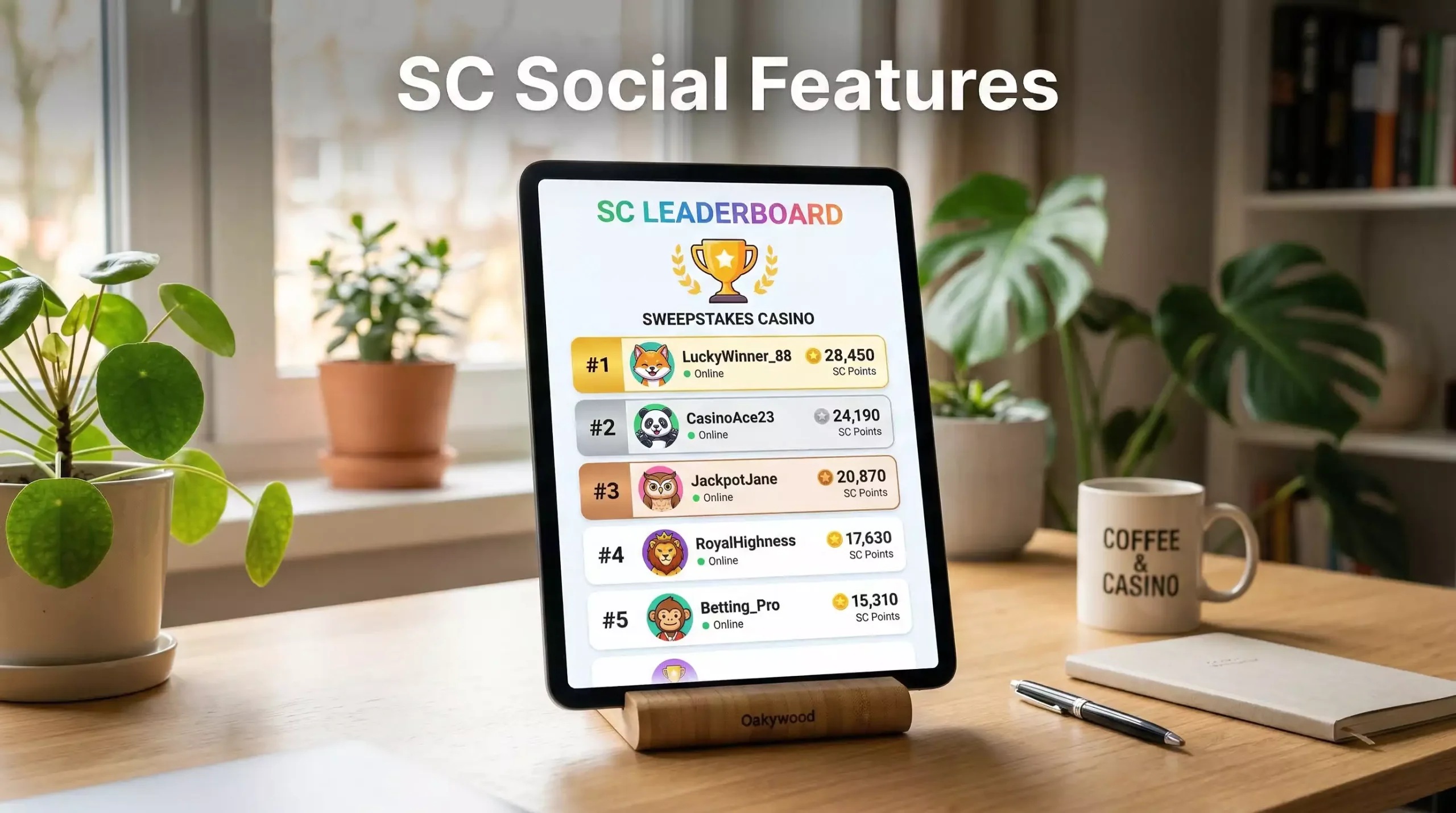
Sweepstakes casinos borrow the word “social” from their social casino predecessors, but the social features themselves vary wildly. Some platforms offer genuine community mechanics — leaderboards, tournaments, chat systems, and collaborative challenges that connect players and add competitive layers to the gameplay. Others use “social” as a legal descriptor with no actual social functionality beyond a shared game server.
The platforms that invest in real social features tend to retain players longer, drive higher engagement, and create organic community-driven growth that supplements paid marketing. For players, social features can add value through tournament prize pools, leaderboard rewards, and the simple psychological benefit of playing alongside others rather than alone. This article covers how the main social mechanics work, which platforms implement them best, and how these features drive the retention patterns that keep the industry growing.
Leaderboards and Rankings: How SC Casinos Gamify Competition
Leaderboards are the most common social feature across sweepstakes casinos. The basic concept is familiar: players are ranked against each other based on a metric — total wagered, biggest win multiplier, most games played, or tournament-specific scoring — and the top-ranked players receive rewards at the end of a defined period.
The implementation varies. Some platforms run daily leaderboards with small SC prizes (1–5 SC for top positions). Others run weekly or monthly competitions with larger prize pools. The ranking metric matters: leaderboards based on total wagered tend to favor high-volume players who spend the most, while leaderboards based on win multipliers or percentage return create a more level playing field where a player wagering 0.10 SC per spin has the same chance at a top spot as someone wagering 10 SC.
The scale of the community these features serve is significant. Over 55 million Americans play sweepstakes games annually, and even a small percentage of that base engaging with leaderboards creates a substantial competitive pool. Platforms that surface leaderboard standings prominently — in the main navigation, on the home screen, or as a persistent widget during gameplay — drive higher participation than those that bury the feature in a submenu.
Tournament-style leaderboards add structured competition. A platform might designate a specific game or game category as the tournament target for a 24-hour or week-long event, with all wagering on that game contributing to the tournament standings. Entry is usually free (you’re wagering SC you already have), and the prize pool is funded by the operator. These events create spikes in engagement around specific games and time windows, which benefits both the platform (higher daily active users) and participating players (SC prizes that supplement normal gameplay returns).
The competitive dynamic also serves an informational purpose. Seeing other players’ win multipliers and standings provides indirect data about game behavior and payout patterns that you wouldn’t have access to in isolated play. It doesn’t reveal RTPs directly, but it gives you a sense of what outcomes are possible and how other players are performing — context that’s otherwise invisible at most sweepstakes platforms.
Chat, Friends, and Community Challenges
Beyond competition, some sweepstakes casinos offer genuine community tools that let players interact with each other beyond the gameplay itself.
In-game chat systems are available at select platforms, primarily in multiplayer formats like fish games, live dealer tables, and tournament lobbies. The chat functionality ranges from basic text messaging to more structured systems with emoji reactions, gifting mechanics, and moderated channels. Chat is most meaningful in live dealer environments, where the shared experience of watching a real dealer and reacting to outcomes in real time creates a social dynamic closer to sitting at a physical casino table.
Friends lists and social connections allow players to add other users, view their activity, and sometimes send small gifts (GC amounts, bonus SC from promotional budgets). This feature is more common at platforms that evolved from the social casino model, where friend mechanics and social graph integration were core retention tools long before sweepstakes functionality was added.
Community challenges — platform-wide goals where all players collectively contribute toward a shared target (total community wagers, total wins over a threshold, etc.) — appear at some platforms as periodic events. When the community hits the target, all participants receive a bonus. These mechanics foster a sense of collective participation and create shared reference points that players discuss on external forums and social media.
The industry’s direction on social features reflects a broader strategic shift. As Camilla Wright, spokesperson for the Social and Promotional Gaming Association, has noted, the organization is focused on fostering a cohesive industry voice through collaboration, with the goal of creating an environment that puts consumers first. Social features are one expression of that consumer focus — they increase the entertainment value of the platform beyond pure gambling mechanics and create community bonds that differentiate sweepstakes casinos from isolated, transaction-only experiences.
How Social Features Drive Player Retention
Social features aren’t just decorative — they’re retention mechanics with measurable impact on player behavior and platform economics.
The connection between social engagement and retention is well-documented in gaming and app economics. When players form relationships within a platform — through leaderboard competition, chat interactions, tournament rivalries, or community achievements — they develop switching costs that go beyond the SC in their account. Leaving the platform means leaving a community, abandoning a leaderboard position, and breaking social connections. These soft barriers to exit are often more effective at retaining players than monetary incentives alone.
Data from Optimove, cited in iGaming Business, shows that betting frequency among sweepstakes players triples after the first month of activity. Social features accelerate that ramp by giving players reasons to return beyond individual gameplay sessions. A daily leaderboard creates a daily reason to log in. A week-long tournament creates a week-long engagement arc. A community challenge creates shared momentum that makes individual sessions feel like contributions to something larger.
For operators, the ROI on social features is favorable. Building a leaderboard system or chat infrastructure costs a fraction of what paid advertising costs per player acquired. A platform that retains 10% more players through social engagement reduces its dependency on expensive new player acquisition — a meaningful efficiency when customer acquisition costs in the sweepstakes space run $50–$100 per player.
For players, the value of social features is both practical (tournament prizes, leaderboard rewards) and experiential (community, competition, shared context). If two platforms are comparable in game quality, payout rates, and bonus terms, the one with active social features will likely deliver a more engaging and ultimately more valuable experience over time. The SC prizes from leaderboards and tournaments add to your balance; the community dimension adds to the reason you keep playing. External communities — Discord servers, Reddit threads, and Facebook groups organized by players themselves — further extend the social layer beyond the platform’s built-in tools, creating ecosystems where strategy tips, promo code sharing, and winner celebrations reinforce platform loyalty even when the app is closed.
Key Takeaway: Social features at sweepstakes casinos — leaderboards, tournaments, chat, friends lists, and community challenges — vary dramatically by platform but meaningfully impact both engagement and value. Leaderboards and tournaments distribute SC prizes that supplement normal gameplay returns. Chat and community tools create social bonds that increase long-term retention. Platforms with active social features deliver a richer experience and additional earning opportunities compared to isolated, play-alone platforms. When comparing SC casinos with similar game libraries and bonus structures, social features are a practical tiebreaker.
Sweepstakes Casino Social Features — More on this topic at sc casino games.
See also Sweepstakes Casino Coin Packages.