
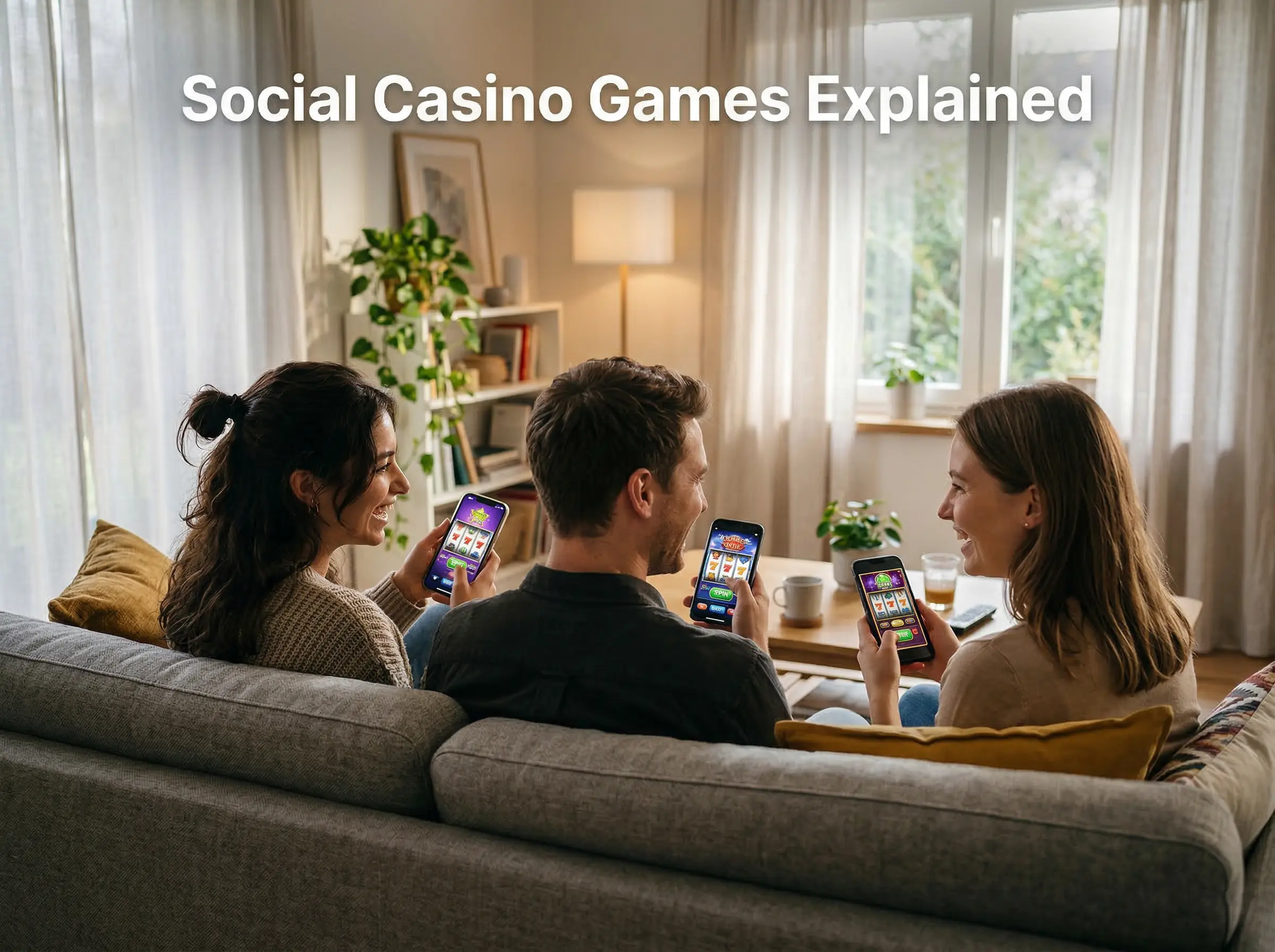
Social casinos and sweepstakes casinos get confused constantly, and the confusion isn’t accidental. Both use virtual currencies, both offer casino-style games, and both position themselves outside traditional gambling regulation. But the business models are fundamentally different, and understanding where one ends and the other begins is essential for anyone trying to navigate the online gaming landscape in the US.
Social casinos are the original play-for-fun model: buy virtual coins, play slots or table games, and keep whatever you win — as more virtual coins. There’s no path to cash. No redemption. No prizes. The currency you wager has no monetary value outside the platform. Sweepstakes casinos took that foundation and added a second currency layer that can be converted to real money, creating the hybrid model that has generated billions in revenue and drawn intense regulatory scrutiny. This article explains what social casinos are, how large the market is, and how they differ from sweepstakes casinos in structure, regulation, and player experience.
What Makes a Casino “Social”: No Redemption, No Prizes
A pure social casino operates on a single virtual currency with no cash-out mechanism. You buy coins, play games, and accumulate or lose those coins within the platform. When your balance hits zero, you either buy more or wait for a free refill. At no point can you exchange your virtual currency for money, gift cards, merchandise, or anything else with real-world value.
This model has been around since the late 2000s, when Facebook gaming drove explosive growth in social casino apps. Zynga Poker, Slotomania, and DoubleDown Casino became household names by offering casino gameplay to audiences who had never visited a real casino. The revenue model was — and still is — microtransactions: small, frequent purchases of virtual currency that fund the free-to-play experience for non-paying users. The global social casino market generated approximately $7.1 billion in gross revenue in 2024, according to Eilers & Krejcik Gaming data cited in KPMG’s sweepstakes industry primer.
The absence of real-money prizes is what keeps social casinos outside gambling regulation. Because you can’t win anything of value, the activity doesn’t meet the legal definition of gambling under most US state laws. There’s no “consideration” exchanged for a “prize” through “chance” — the three-element test that defines gambling in most jurisdictions. You’re paying for entertainment, like buying tokens at an arcade or credits in a mobile game. This legal clarity is the social casino’s primary advantage over sweepstakes casinos, which face mounting legislative challenges precisely because their prize-redemption mechanism blurs the line between entertainment and gambling.
Major social casino operators include Playtika (Slotomania, House of Fun, Caesars Casino), SciPlay (Jackpot Party, Quick Hit Slots), and Zynga (Zynga Poker, Hit It Rich). These companies are publicly traded, regulated as software/entertainment firms, and generate billions in combined revenue without holding a single gambling license.
The .5 Billion Social Casino Market
The social casino market is large, mature, and still growing — just not at the pace of the sweepstakes segment that branched off from it.
According to Grand View Research, the global social casino market was valued at $8.51 billion in 2024 and is projected to reach $14.31 billion by 2030, growing at a CAGR of 8.9%. That’s steady, respectable growth for a mature digital entertainment category — but it’s a fraction of the 60–70% compound growth rate that sweepstakes casinos sustained between 2020 and 2024.
The market breaks down by game type in a way that mirrors the sweepstakes space. Slots dominate, accounting for roughly 56% of social casino revenue. Table games, poker, bingo, and casual formats fill out the remainder. Mobile is the primary distribution channel, with iOS and Android apps driving the vast majority of social casino revenue through in-app purchases.
The business model is highly concentrated. A handful of publishers — Playtika, SciPlay, Aristocrat (through its Pixel United division), and a few others — control the majority of the market. These companies have decades of experience in monetizing free-to-play audiences and have optimized their in-app purchase funnels to a degree that newer sweepstakes operators are still learning to match.
One market dynamic worth noting: social casino revenue growth has decelerated partly because of sweepstakes casinos. Players who previously spent money on virtual coins with no cash-out path now have the option to spend the same money at a sweepstakes casino where their purchases might lead to real prizes. The sweepstakes model hasn’t killed social casinos — the market is still growing — but it has siphoned the highest-spending segment of the audience toward platforms that offer a return on their investment.
Social Casino vs Sweepstakes Casino: Key Differences
The core distinction is redemption. Social casinos offer no path to cash. Sweepstakes casinos offer a dual-currency system where one currency (Sweeps Coins) can be redeemed for real money prizes. Every other difference flows from this structural divergence.
On regulation, social casinos operate almost entirely unregulated from a gambling perspective. They’re classified as entertainment software, subject to general consumer protection and app store policies but not gaming commissions. Sweepstakes casinos exist in a gray area — not regulated as gambling (they claim they aren’t), but increasingly targeted by state legislators and enforcement agencies who disagree with that classification.
On player demographics, the overlap is significant but not complete. Social casino players tend to skew older and treat the experience as entertainment — the same psychological slot experience without financial stakes. Sweepstakes casino players are more likely to be motivated by the possibility of real prizes. Both audiences buy virtual currency, but their reasons for doing so are different, and that difference has implications for spending patterns and session behavior.
On legal risk, social casinos face minimal exposure. No state has banned social casinos as gambling. Sweepstakes casinos face existential legal threats in a growing number of states, with five bans enacted in 2025 and more expected. The sweepstakes model’s legal vulnerability is a direct consequence of adding the redemption layer that social casinos deliberately avoid.
The industry perspective is divided. Jonathan Michaels of Michaels Strategies has argued that sweepstakes operators have been unfairly characterized — that they’re using established social casino mechanics and adding a new layer on top, not creating something fundamentally different from what social casinos have done for years. Critics, including the American Gaming Association and multiple state regulators, counter that the redemption mechanism transforms the activity into de facto gambling regardless of how the operator frames the purchase. The debate isn’t academic: it’s the central legal question determining whether sweepstakes casinos survive or get regulated out of existence.
For players choosing between the two models, the decision reduces to one question: do you want the possibility of real money coming back? If yes, sweepstakes casinos are the relevant option, with the understanding that the legal landscape is shifting and access may change. If you’re playing purely for entertainment and the cash-out pathway doesn’t matter, pure social casinos offer a simpler, legally uncontested, and often more polished gaming experience — backed by publishers with decades of game design expertise.
Key Takeaway: Social casinos and sweepstakes casinos share surface-level similarities — virtual currency, casino-style games, free-to-play access — but differ fundamentally on redemption. Social casinos offer no path to cash, which keeps them outside gambling regulation entirely. Sweepstakes casinos add a redeemable currency layer that creates real-money prize potential but also attracts regulatory scrutiny. The social casino market generates $8.5+ billion annually and continues growing, though its highest-spending users are increasingly migrating toward sweepstakes platforms where purchases carry the prospect of a return.
Social Casino Games Explained — More on this topic at sc casino games.
See also Sweepstakes Casino VIP Programs.