
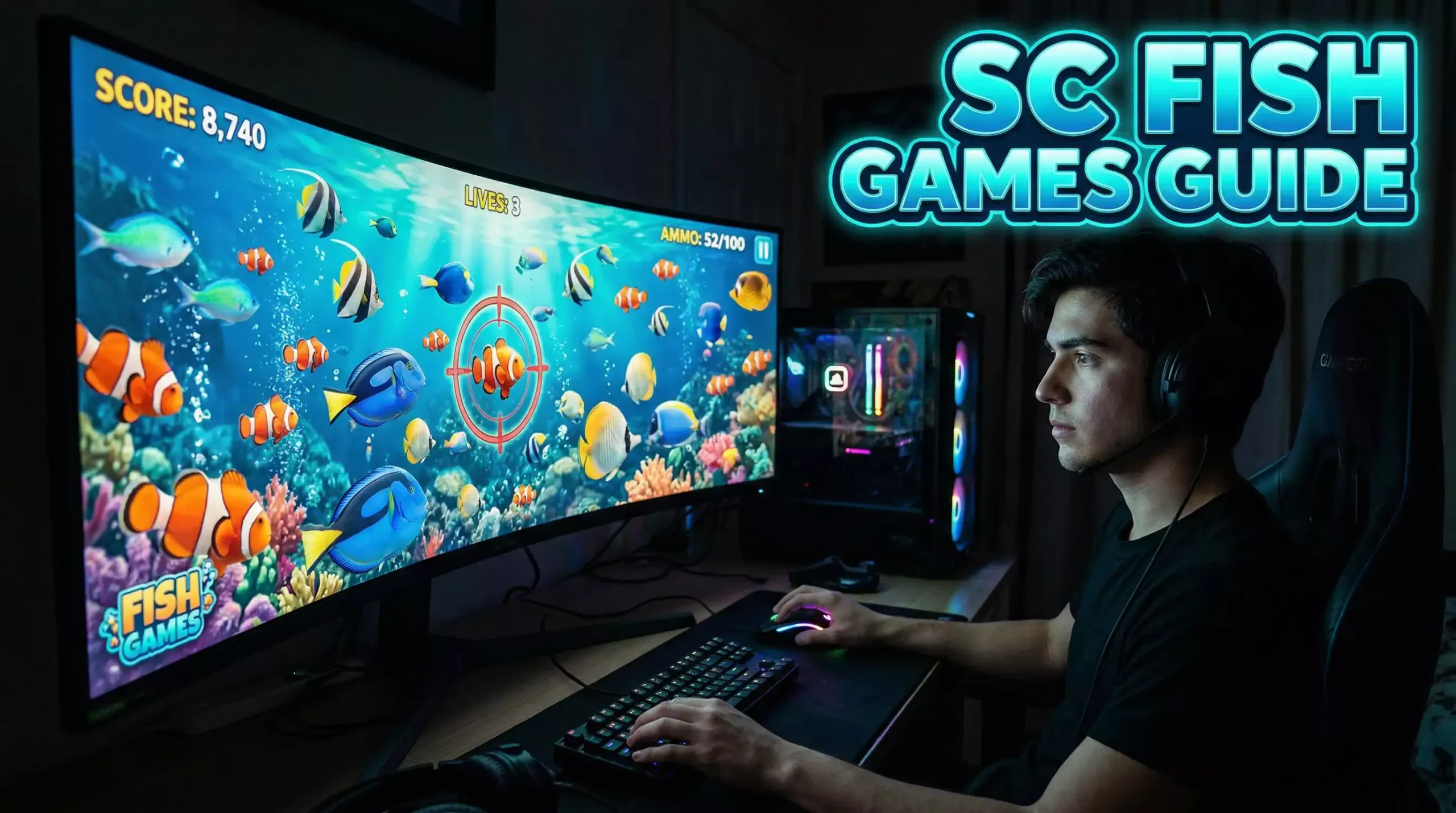
Fish games are the oddball of the sweepstakes casino world. They don’t look like slots, they don’t play like table games, and they carry a skill-based reputation that sets them apart from every other format on the platform. The gameplay is closer to a classic arcade shooter: you aim at fish (or sea creatures, or bosses) swimming across the screen, fire projectiles that cost SC per shot, and collect payouts based on what you hit. Larger or rarer targets pay more. Your aim, timing, and target selection influence your results — at least partially.
Fish table games have a long history in brick-and-mortar gaming rooms, internet cafes, and Asian gambling markets, where they’ve been popular for over a decade. Their migration to online sweepstakes platforms brings a niche but dedicated audience — players who specifically seek out the fish game format and choose platforms based on the quality and variety of fish titles available. This article covers how the mechanics work, where the line between skill and chance actually falls, and which SC casinos offer the best fish game selection.
How Fish Games Work: Skill, Timing, and SC Payouts
The gameplay loop in a fish game is distinct from every other sweepstakes casino format. You enter a multiplayer room where a variety of sea creatures move across the screen in patterns — some slow and predictable, others fast and evasive. Each creature has an assigned payout multiplier. Small fish might pay 2x your shot cost. Medium creatures pay 5–15x. Boss-level targets — giant sharks, golden dragons, mechanical krakens — can pay 50x, 100x, or more.
You fire shots by clicking or tapping on targets. Each shot deducts a fixed amount of SC from your balance (determined by the weapon tier you select — bigger weapons cost more per shot but deal more damage). When a creature takes enough damage to be captured, its payout multiplier is applied to your shot cost and credited to your balance. A weapon costing 0.10 SC per shot that captures a 20x fish returns 2 SC.
The multiplayer element is significant. Multiple players share the same screen, shooting at the same pool of targets simultaneously. You can see other players’ shots and targeting patterns, which creates a competitive dynamic: if two players target the same high-value boss, the one who lands the killing shot collects the payout. Some games split rewards proportionally based on damage dealt; others operate strictly on last-hit mechanics.
The format’s appeal is rooted in the perception of agency. Unlike a slot where you press spin and wait, fish games ask you to aim, prioritize targets, manage your ammunition budget, and adapt to changing screen conditions. The experience feels more like playing a video game than pulling a lever — and that perception, whether fully justified or not, attracts a specific player demographic. This is meaningful in a market where over 55 million Americans play sweepstakes games annually. Fish games carve out a niche within that audience by offering something that doesn’t exist in slots, table games, or crash formats.
Most fish games include special weapons, power-ups, and boss events that trigger periodically. Laser attacks, freeze abilities, and area-of-effect bombs create strategic moments where spending more SC per shot is justified by the higher capture probability. These mechanics add depth but also increase the rate at which SC gets consumed, making bankroll management more complex than in simpler game formats.
Skill vs Chance in Fish Table Games
The u201Cskill-basedu201D label that fish games carry deserves scrutiny. Player skill — aiming accuracy, target prioritization, weapon selection, and timing — does influence outcomes within a session. A player who consistently targets high-value creatures, manages their shot budget efficiently, and avoids wasting ammunition on low-payout fish will generally outperform a player who fires randomly. That much is real.
But the underlying hit probabilities are controlled by the game’s algorithm, not purely by the player’s aim. When you fire at a fish, the game runs a probability check that determines whether the shot u201Ccapturesu201D the target. That probability is set by the game developer and varies based on the creature’s value: high-payout targets have low capture rates, and low-payout targets have high capture rates. Your aim puts the shot on target, but the algorithm decides whether the capture succeeds. This is why you can sometimes fire dozens of shots at a boss creature and fail to capture it — not because you missed, but because the capture probability per shot is intentionally low.
The result is a hybrid model: skill affects which targets you engage and how efficiently you spend your SC, but chance determines the capture outcome of each individual shot. The house edge is embedded in the capture probability curves, just as it’s embedded in the RTP of a slot or the zero pockets on a roulette wheel. Over a large number of shots, the mathematical expectation converges toward a fixed return rate regardless of player skill.
This distinction matters for managing expectations. Fish games feel more skill-based than they mathematically are. The perception of control keeps players engaged longer and encourages higher per-session spending — the same psychological dynamic that makes crash games stickier than slots. Recognizing the hybrid nature of the format helps set realistic expectations: skill helps you perform above the average within a session, but it doesn’t eliminate the house edge over time.
SC Casinos with the Best Fish Game Selection
Fish game availability at sweepstakes casinos is uneven. The format requires specialized game providers and a different technical integration than standard slot or table game content, which means not every platform carries it.
Among the major sweepstakes casinos, platforms that have invested in game library diversity tend to offer the best fish game selections. Stake.us carries multiple fish game titles sourced from providers specializing in the format, including variations with different visual themes, weapon systems, and multiplier structures. The platform’s broad game portfolio — a product of its crypto casino heritage — extends naturally to niche categories like fish games.
Pulsz and WOW Vegas have added fish game content over the past year as part of their library expansion efforts. The selection is smaller than dedicated fish game platforms but covers the core experience. Both platforms carry at least one or two fish titles, typically with multiple room tiers catering to different bankroll levels.
The broader market context supports continued expansion of fish game availability. According to Waterhouse VC, 40+ new sweepstakes operators launched in 2024–2025, many seeking to differentiate through game variety. Fish games are one of the categories where differentiation is easiest — the format is underserved at most established platforms, which means a new operator launching with a strong fish game library can attract a dedicated player segment that larger competitors have ignored.
Players whose primary interest is fish games should evaluate platforms based on three criteria: the number of fish titles available, the range of room tiers (low-stakes rooms for casual play, high-stakes rooms for experienced players), and whether the platform’s SC economy is favorable for fish game play specifically. Fish games consume SC at a faster rate per minute than most other formats because every shot is a separate wager, so platforms with generous daily logins and low minimum redemption thresholds are particularly valuable for fish game enthusiasts.
Key Takeaway: Fish games are the most distinctive format at sweepstakes casinos — multiplayer arcade shooters where you aim at targets, manage ammunition budgets, and collect payouts based on capture multipliers. The skill element is real but limited: your aim and target selection influence efficiency, but capture probabilities are algorithm-controlled with a built-in house edge. Stake.us offers the broadest fish game selection, with Pulsz and WOW Vegas carrying smaller but growing libraries. The format consumes SC faster than slots or table games due to its rapid-fire mechanics, so bankroll awareness is especially important for fish game sessions.
Sweepstakes Casino Fish Games — More on this topic at sc casino games.
See also High RTP Slots at Sweepstakes Casinos.